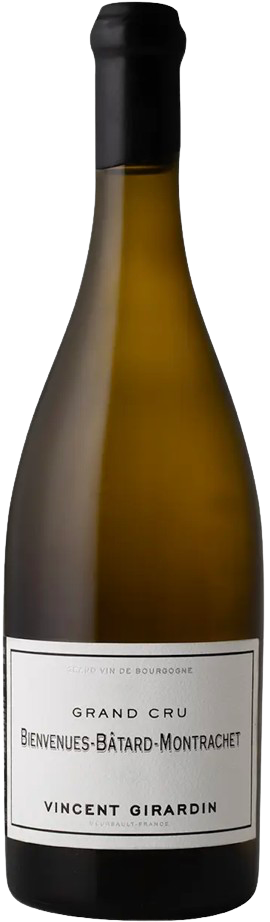
A Very Small Perimeter at the Northern End of the Bâtard
On the Montrachet slope the grands crus are arranged as a staircase: Chevalier-Montrachet occupies the upper step, between 265 and 290 metres, the Montrachet the middle step between 250 and 270 metres, Bâtard-Montrachet the lower step between 240 and 250 metres. Bienvenues-Bâtard-Montrachet is the northern extension of that lower step, a rectangle of 3.59 hectares in production, detached from the Bâtard and raised into a separate appellation.
Its administrative singularity is clear: unlike the Montrachet and the Bâtard, which are cut in two by the boundary between the communes, Bienvenues lies entirely within Puligny-Montrachet — like Chevalier-Montrachet. At the other end of the Bâtard, symmetrically, Criots-Bâtard-Montrachet is entirely within Chassagne. The slope therefore reads as follows: two crus shared in the centre, two Puligny crus to the north, one Chassagne cru to the south.
The Terroir: The Soils of the Bâtard, on a Pocket Handkerchief
The geological description is that of the lower slope: brown limestone soils, thick and clayey, over a Jurassic bedrock dated to around 175 million years ago, between 240 and 250 metres in altitude. We are far from the thin, stony soils of Chevalier or the thin layer of earth of the Montrachet: here the earth is deep, the water reserve more generous, the vine less constrained.
What distinguishes Bienvenues from its great neighbour therefore has less to do with the nature of the soil than with nuances of position and depth, over a minute area where every row counts. Practitioners agree in finding there a little more finesse and a little less raw power than in the Bâtard: the matter is the same, the line is finer. On a cru of three and a half hectares, a difference of a few metres in soil depth or gradient is enough to create an identity.
Climate: The Constraints of the Lower Slope
The climate is that of the Côte de Beaune, temperate with a slight continental tendency: cold winters, wet springs, hot and sometimes stormy summers. Chardonnay buds slightly earlier than pinot noir and remains susceptible to spring frosts — a more marked risk at the foot of the slope, where cold air flows down and accumulates, than on the steps above.
The low position is, on the other hand, warm during the growing season: ripening there is more regular and more advanced than higher up the slope, and the clayey soils store heat and then give it back. On a cru of this size, vineyard management counts as much as terroir: low yields — around 40 hectolitres per hectare — disbudding, green harvesting and sorting at the harvest are the tools that keep the richness of the soil from turning into heaviness in the wine.
The Style of the Wines: Finesse Rather than Force
The robe is gold with mineral glints. The nose mixes spice, honey, dried fruits, fern and butter, in a register common to the whole slope, but the balance on the palate is what makes the reputation of the cru: harmonious, structured, unctuous and deep, without the sometimes demonstrative amplitude of the Bâtard. It is a wine of fine chiselling — the generosity of the lower slope brought back to a more delicate scale, closer to the style of Puligny.
Vinification follows the Burgundian canon: hand harvesting and sorting, pressing, settling, alcoholic fermentation conducted between 18 and 24°C, malolactic in barrel or in tank, ageing on lees with bâtonnage. The wine needs at least ten to fifteen years, longer in the great vintages. It is served between 12 and 14°C with lobster, crayfish, white fish in a sauce, foie gras or poultry.
A Grand Cru Born of the Bâtard
The climat of Les Bienvenues belongs to the toponymic family of the Bâtard: these neighbouring names — Chevalier, Pucelles, Bâtard — refer to a legend of seigneurial inheritance related by Marie-Hélène Landrieu-Lusigny in her study of Burgundian lieux-dits, in which the lord of Puligny is said to have divided his lands between his eldest son, his daughters and his illegitimate son. The closeness of the name says the essential: Bienvenues is a piece of the Bâtard that eventually obtained an appellation name of its own.
The INAO register links recognition of the cru to the decree of 31 July 1937, published on 11 August following at the same time as its four neighbours on the slope; the cahier des charges in force derives from decree no. 2011-1822 of 7 December 2011. The five appellations of the slope were in fact revised together, a national objection procedure having covered simultaneously, in December 2010, the cahiers des charges of Montrachet, Chevalier-Montrachet, Bâtard-Montrachet, Bienvenues-Bâtard-Montrachet and Criots-Bâtard-Montrachet.
A Structural Rarity
With 3.59 hectares in production and about 172 hectolitres a year, Bienvenues-Bâtard-Montrachet ranks among the smallest appellations in France: some 22,930 bottles a year, against 70,660 for the neighbouring Bâtard. Only Criots-Bâtard-Montrachet, at the other end of the slope, produces less.
This rarity is structural rather than circumstantial: the delimited area, 3 ha 68 a 60 ca, cannot be extended, and Burgundian fragmentation means that each grower holds only a fraction of it. The result is cuvées of just a few barrels, with the differences in style that different hands produce on one and the same tiny terroir. As everywhere in Burgundy, the map of owners shifts with successions and tenancy agreements: any breakdown of parcels holds good only for the date on which it was recorded.
The grape varieties of Bienvenues-Bâtard-Montrachet
Bienvenues-Bâtard-Montrachet wines on 1001caves
Detailed pages: the cuvée, the estate, the drinking window and the bottles for sale between collectors.