A Rectangle of Fifty Hectares at the Foot of the Slope
The Clos de Vougeot occupies most of the territory of the commune of Vougeot, not far from the source of the Vouge, on a gently sloping hillside facing east. Its official area — 50 hectares 96 ares 54 centiares, that is half a square kilometre — makes it the largest grand cru of the Côte de Nuits, where the average grand cru of the Côte-d'Or is around six hectares. Its neighbourhood is prestigious: the Musigny looks down on it from the north-west, Échezeaux and Vosne-Romanée extend it to the south.
Its physiography, on the other hand, is atypical for a grand cru. The clos lies broadly between 240 and 260 metres in altitude, with an average gradient of only 3.8%: 80% of its area falls into the "gentle slope" category, at less than 5%. Above all, it is one of the rare grands crus of the Côte to come right down to the Dijon-Beaune road, the D974 — only Mazoyères-Chambertin shares that situation. Whereas grands crus are usually set on the upper and middle parts of the slope, the Clos runs from the hillside down to the piedmont. That is one reason why its grand cru rank is sometimes debated.
The Terroir: A Clos That Is Anything but Uniform
This is the decisive point for understanding the differences between cuvées. As the reference literature sums it up, the terroir of the Clos "is far from uniform: gravelly and stony in its upper part, it becomes more clayey lower down", while keeping free-draining soils everywhere that dry out quickly after rain. The best land is the upper ground, lean and stony, close to the château: it runs from Petit Maupertuis in the south to Le Musigni and Montiottes Hautes in the north. The lower part, almost flat and heavier, is the part that runs along the road. Between the two, a middle band — Baudes, Marei, Chioures — provides the transition. Geologists at the BRGM drew a famous conclusion from this: despite the fragmentation, the wine "continues to be systematically finer and more delicate in the higher parts and heavier at the foot of the slope". Subsoil and soil therefore retain all their importance, whoever the owner may be.
Modern mapping has qualified this three-tier reading without contradicting it. The Clos had no detailed geological documentation before the report by the firm ADAMA — "Caractérisation physiographique, géologique et pédologique du Clos Vougeot", signed by Françoise Vannier and Emmanuel Chevigny in 2023 for the ODG of the grand cru — drawn up at the very fine scale of 1:2,500, with a hundred and fifty auger borings. It shows a clos formed of six or seven different lithologies, dominated not by the Jurassic but by Oligocene formations: limestone conglomerates with a salmon-pink clayey limestone cement, accompanied by ochre to reddish marls. The Prémeaux limestone (Bathonian-Callovian) was reached only at the bottom of soil pits, in Montiottes Basses, Plante l'Abbé and Le Musigni. And 15 to 20% of the area rests on Quaternary alluvial fans: the largest, linked to the combe d'Orveau, carries the château itself and runs along the northern edge; two others, coming from the combe of Vosne-Romanée, explain the small ridges of the centre and the south. Three small valleys and three ridges thus undulate discreetly within the walls.
Climate and Exposure
The climate is temperate with a slight continental tendency: pronounced winters, wet and frost-prone springs, hot summers punctuated by storms. The Clos is favourably exposed to the east and south-east; because of the generally low gradient, the parts turned to the north-east and north receive only grazing sunlight, which is nonetheless judged advantageous. The free-draining soils partly compensate for the flatness of the lower part of the clos.
As everywhere in the Côte-d'Or, the calendar has shifted. The archives record August harvests in the Côte de Nuits as early as 1422, a very early 1865 vintage very rich in sugars, then the heatwave of 2003 which saw some estates harvesting in mid-August, a month before the usual date. Across fifty hectares of such varied soils, these warm vintages accentuate the gaps between the upper parcels, early and lean, and the lower parcels, more clayey and later.
The Style of the Wines and Their Ageing
Clos-vougeot has long been described as a very full-bodied wine, scented with truffle and violet, dense and sturdily built. Pinot noir gives here deeply coloured, rich wines of moderate tannin and good ageing potential; the crop is hand harvested, sorted, generally destemmed, and ageing classically runs for twelve to twenty-four months before fining, filtration and bottling. Allow ten to twenty years of ageing, longer in the great vintages.
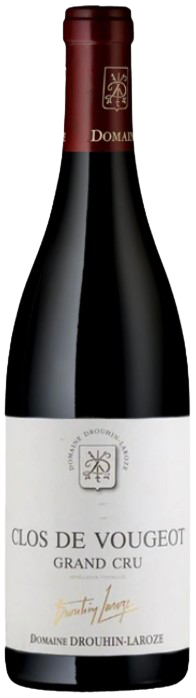
But to speak of "the" clos-vougeot is a misuse of language: more than eighty different cuvées are born each year from the same name, from parcels ranging from two and a half hectares to twenty-one ares, with very diverse styles of winemaking. The internal upper/lower hierarchy remains a useful benchmark, but it is not mechanical: a tasting of about twenty-five cuvées of the 2020 vintage, published by La Revue du vin de France in its winter 2024 issue, singled out wines from the lower part, usually underestimated. The grower's work counts here as much as the topographic rating of the parcel.
Cîteaux, the Château and the Confrérie
The abbey of Cîteaux received land on the banks of the Vouge from 1100; from 1111 the Cistercians had their clos planted with pinot noir and entrusted its cultivation to the lay brothers. The name appears for the first time in a bull of Pope Alexander III in 1164. The clos was formed and walled around 1330. Under the pontificate of Clement VI (1342-1352) the monks divided it into three climats in order to select the "cuvée du pape", alongside the "cuvée du roi" and the "cuvée des moines" — the first explicit recognition that not all parts of the clos are equal. In 1364, Urban V even threatened the abbot of Cîteaux with excommunication if he continued to supply Avignon with clos-vougeot; the threat was lifted in 1370. The present château was built in 1551 by dom Jean XI Loisier.
Confiscated at the Revolution, the clos was bought in 1818 by the banker Gabriel-Julien Ouvrard, who gave it to his son Victor. The Ouvrard heirs put it up for auction in 1887; the sale failed, and it was in 1889 that fifteen merchants from Beaune, Dijon and Nuits-Saint-Georges bought it: the fragmentation began. The appellation d'origine contrôlée was created in 1937. Restored after the Second World War, the château, which still houses the monks' old winemaking equipment, has belonged to the Confrérie des Chevaliers du Tastevin since 1944; the brotherhood meets there twice a year for the tastevinage. In 1855, Jules Lavalle ranked clos-vougeot "hors ligne, tête de cuvée no. 1", alongside the Romanée-Conti, the Chambertin and the Clos de Bèze.
The Lieux-Dits of the Clos and Their Estates
The Clos is itself subdivided into lieux-dits whose names tell the story of the monastic enclosure. Le Musigni, at the top in the north — which Marie-Hélène Landrieu-Lussigny links to a Gallo-Roman villa belonging to one Musinus — Grand and Petit Maupertuis (from Malo Pertuso, the bad passage), Plante l'Abbé, which designates the plantings ordered by an abbot of Cîteaux, Les Chioures, Les Baudes hautes, basses and Saint-Martin, Les Marei haut and bas, Les Montiottes hautes and basses, and finally Les Dix Journaux and Les Quatorze Journaux, from the name of the old land measure corresponding to a day's work.
The location of a parcel within this chessboard is often an indication of style. In the detailed survey published by Wikipedia, Domaine du Château de la Tour — the only estate to vinify its clos-vougeot within the walls — farmed Les Dix Journaux and Marei bas in the north; Méo-Camuzet a parcel of about three hectares in a single block in Les Chioures; Anne Gros, Michel Gros and Mongeard-Mugneret parcels in Grand Maupertuis, right at the top; Grivot one hectare 86 ares in Les Quatorze Journaux, at the bottom; Mortet the lowest and northernmost part, in Montiottes basses; Louis Jadot nearly two and a half hectares in the Baudes sector. Since these parcels change hands with successions, this breakdown holds good only for its date.
The grape varieties of Clos de Vougeot
Clos de Vougeot wines on 1001caves
Detailed pages: the cuvée, the estate, the drinking window and the bottles for sale between collectors.