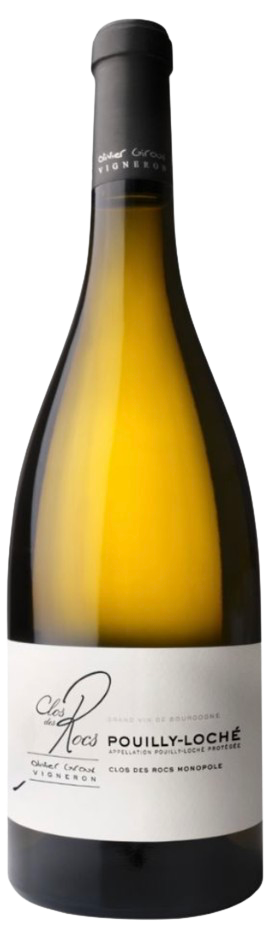
A Hamlet of Mâcon, at the Southern Tip of Burgundy
Pouilly-Loché is one of the rare Burgundian appellations that does not bear the name of an existing commune: Loché merged with Mâcon, and administratively the appellation area now covers only the territory of the town of Mâcon. The vineyard occupies the eastern flank of the easternmost ridge of the Monts du Mâconnais, facing the Saône plain and the Bresse, at the southern extremity of Saône-et-Loire.
It is a minuscule vineyard: some thirty hectares in production, one of the smallest appellation d'origine contrôlée surfaces in Burgundy, for an average volume of around 1,800 hectolitres made by a dozen estates. More than 70% of that production is bottled. At that level of rarity, Pouilly-Loché is not to be found everywhere: it is a grower's and a cellar-door wine more than a supermarket-shelf wine.
The Terroir: Jurassic Limestones and Marls, Triassic Sandstone on the Crest
The ridge that carries the vineyard runs north to south and exposes, on its eastern flank, sedimentary formations of the Secondary era: essentially limestones and marls — clayey limestones — of the Lower and Middle Jurassic, with the Bajocian and Bathonian levels, and, at the top of the slope, Triassic sandstone. This stacking of a sandstone basement beneath a limestone mantle is the geological signature of the Loché-Vinzelles sector.
The soils follow directly, and they change in nature as one descends the slope: rather acidic and beige in colour at the top of the slope, on the sandstone; clay-limestone and red-brown in the middle and lower slope; locally very shallow over hard limestone. It is this variation across a few hundred metres that underpins the identity of the "climats" — the registered lieux-dits — Aux Barres, Aux Scellés, Au Bûcher, En Chantone and Les Mûres, whose names producers have shown on the label since the 1980s.
A Slope Facing the Rising Sun, a Southern Burgundy Climate
The delimited parcels all lie on the east-facing flank, between 210 and 280 metres in altitude, overlooking the village of Loché. Exposure to the rising sun brings bright mornings and more temperate afternoons: ripening takes place without excessive heat, which preserves acidity while allowing thoroughly ripe harvests.
The climate is oceanic, tempered by southern influences. Extremes are limited on two sides: the Monts du Charollais, to the west, screen out damp influences; mild air currents rising up the Rhône corridor warm the vineyard from the first fine days. The mean annual temperature is 11°C, total rainfall does not exceed 800 millimetres a year and rain stays moderate during the growing season. As everywhere in the Mâconnais, the vine is mostly trained using the "taille à queue du Mâconnais", an arched pruning that distributes the sap better and protects the vines from spring frost.
The Style of the Wines: Opulence and Silkiness
In its youth, pouilly-loché shows a pale, crystalline golden robe that takes on deeper tones with age. The aromatic palette is broad: citrus (grapefruit, lemon), white-fleshed fruit, apricot, acacia flower and hawthorn, evolving towards notes of dried fruit, hazelnut and honey after a few years.
On the palate, the appellation's hallmark is opulence and silkiness, tempered by a minerality that comes from the limestone soils and a liveliness that the eastern exposure preserves. Depending on the climat, the wine leans towards roundness or towards tension. Usual cellaring runs between two and five years, and can reach a good ten years in great vintages. Served between 11 and 13°C, it accompanies fish, seafood and shellfish, white meats and Mâconnais goat's cheeses.
Pouilly-Loché or Pouilly-Vinzelles? What Really Separates Them
The confusion between the two appellations is constant, and it has a genuine regulatory cause. The geographical area of Pouilly-Loché is confined to the territory of Mâcon alone, that is, to the former commune of Loché. That of Pouilly-Vinzelles, by contrast, extends across two communes: Vinzelles and Mâcon — Loché included. The practical consequence: a grower whose vines lie in the Loché sector may claim the Pouilly-Vinzelles appellation if he wishes, whereas the reverse is impossible — a wine from Vinzelles can in no case be sold as Pouilly-Loché. This is an asymmetry, not an equivalence, and it is the point most often stated the wrong way round.
The rest is history. In the Middle Ages, Loché came under the seigneury of Vinzelles; the two villages share the same ridge, the same geology and the same exposure, and together founded the "Cave coopérative des Grands crus blancs" in 1929. The two appellations were recognised by the same judgment of the Mâcon court in 1931, then confirmed by the same decree of 27 April 1940. They are twins, but not interchangeable.
From the Villa Lopchiacum to the Premier Cru Les Mûres
The site has been occupied since antiquity: excavations carried out during building works uncovered the foundations of a large Roman villa, the "villa Lopchiacum", probably the origin of the village's name. The vine prospered here under the bishopric of Mâcon and the influence of the monks of Cluny, twenty kilometres to the west; the seventeenth-century cellars and vat houses still standing in the village bear witness to it. In the nineteenth century, the wines of Loché were commonly sold under the name "Pouilly", from a nearby hamlet of good repute — a practice that spoke of the cru's recognised quality, but long deprived it of a name of its own.
Recent history is one of emancipation. After living in the shadow of Pouilly-Fuissé, the appellation has been carried since the late 1990s by a generation of growers who vinify at home, bottle their parcels separately and export. The outcome of that work: on 18 November 2024 the Ministry of Agriculture signed the cahier des charges recognising a Premier Cru at Pouilly-Loché, the climat Les Mûres, covering 7.09 hectares, which may appear on labels from the 2024 vintage. The cahier des charges is modelled on that of Pouilly-Fuissé: compulsory hand-harvesting, herbicides banned, yield limited to 58 hl/ha, ageing until 1 July following the harvest.
The grape varieties of Pouilly-Loché
Pouilly-Loché wines on 1001caves
Detailed pages: the cuvée, the estate, the drinking window and the bottles for sale between collectors.