Where the Chambertin Lies
The Chambertin area lies entirely within the commune of Gevrey-Chambertin, south of Dijon, in the Côte-d'Or. The climat occupies the middle of the slope, west of the route des Grands Crus, between roughly 240 and 280 metres in altitude according to the BIVB, facing east. It sits more or less at the centre of the string of nine grands crus of the commune: Chambertin-Clos de Bèze borders it to the north, Latricières-Chambertin to the south, and on the other side of the road Griotte-Chambertin and Charmes-Chambertin face it to the east.
The nine grands crus together form a continuous band about two kilometres long by five hundred metres wide, just south of the village. This is the northernmost section of the grands crus of the Côte: beyond Gevrey to the north, the hierarchy stops at premier cru. Within that band, the Chambertin and the Clos de Bèze occupy the best-placed position on the slope — neither too high on the lean scree, nor too low on the deep spreads.
The Terroir: Hard Limestones and Bajocian Marls
The appellation rules describe a geology of great sobriety. The Côte de Nuits is here a straight, tectonic relief running north-south for some twenty-five kilometres, separating the limestone plateaus of the Hautes Côtes to the west (400 to 500 m) from the plain of Bresse to the east (about 250 m). The Chambertin parcels lie at the foot of the relief, where they occupy a slight shelf. The lower, gently inclined part rests on a substrate of hard limestone — once quarried as dressed stone — capped by a level of marl, that is to say clayey limestone, identifiable in the landscape because it traces a slight concavity beneath the main slope. The whole sequence dates from the Bajocian, Middle Jurassic. One decisive detail: the vine parcels do not rise above the top of these marls.
This marl-and-limestone substrate is masked by a thin layer — a few decimetres to a metre — of spreads mixing scree with red clays and silts derived from the weathering of the subsoil and of the relief above. The soils are little evolved, generally carbonate-rich, shallow, but free-draining despite a high clay content. The marl level is probably the source of temporary water flows that make up for the soil's small water reserves, while the slope carries off any excess. This combination — little soil, water precisely when it is needed, perfect drainage — is what the appellation rules call the "adequate depth of the soils" and their "particular particle size".
Climate, Exposure and Vineyard Management
The climate is cool oceanic, tempered by continental and southern influences carried up the Rhône-Saône corridor: moderate, regular rainfall of around 750 millimetres a year, with no marked summer drought, and an annual mean of 10.5°C. East of the Morvan and the Burgundian plateaus, the Côte enjoys a climatic shelter that gives it a thermal advantage and a rainfall deficit notable for the region. The topographic position of the parcels shields them from frost and morning fog, while the east-facing exposure warms the soil rapidly at the end of the night.
Vineyard management is the demanding regime of the whole Côte de Nuits: a minimum density of 9,000 vines per hectare, rows no more than 1.25 metres apart, pruning limited to eight buds per vine, a maximum load of 8,000 kilos per hectare. Irrigation is forbidden, as are continuous presses and the use of wood chips. The grapes must reach a sugar content of at least 198 grams per litre of must, for a minimum natural alcohol level of 11.5%. The wines are aged at least until 15 June of the year following the harvest and may not be released to market before 30 June.
The Style of the Wines and their Ageing
Chambertin appears in an intense, deep red, with violet glints in its youth. The nose blends red fruit — raspberry, redcurrant — with black fruit, blackcurrant to the fore, alongside floral notes of rose and violet, undergrowth, liquorice and spice. On the palate, the concentration gives a sense of power, balance and harmony; the attack is lively, the aromas open out broadly and the finish combines unctuousness and elegance. This is the most sturdily built face of Burgundian pinot noir, in the direct line of the Gevrey style.
Ageing is the cru's signature: ten to twenty years as a matter of course, longer in the great vintages, the appellation rules speaking soberly of "considerable longevity". The wine is served at around 13 to 16°C and calls for dishes on its scale: game grilled or in a wine sauce, lamb in sauce, coq au vin, rib of beef, washed-rind cheeses. One honest caveat is in order, though: with more than twenty owners across thirteen hectares, quality varies appreciably from one estate to another, and not every bottle labelled Chambertin lives up to the promise of the name.
Chambertin and Clos de Bèze: The Rule That Exists Nowhere Else
This is the least well understood point about the appellation. The Chambertin rules state that "the parcels delimited for harvesting the grapes, following in this a traditional usage, correspond to the two lieux-dits 'Chambertin' and 'Clos de Bèze'". In other words, the area of AOC Chambertin takes in the neighbouring climat. A ruling in 1932 had authorised the growers working the Clos de Bèze parcels to sell their wines under the name "Chambertin-Clos de Bèze" or under the name "Chambertin"; the previous year, an initial ruling had on the contrary restricted use of the name "Chambertin" to the lieu-dit of that name alone. Traffic therefore runs one way only: a wine from the Clos de Bèze may be sold as Chambertin, a wine from the Chambertin may never be sold as Chambertin-Clos de Bèze.
In practice the option is little used: the Clos de Bèze enjoys a reputation of its own that is at least equal, and nothing encourages its owners to give up its name. None of the commune's seven other grands crus holds this right — the only other exception at Gevrey being the Charmes-Chambertin / Mazoyères-Chambertin pairing, which works on a comparable mechanism. That neighbourly arrangement also explains why published surface figures for the Chambertin vary from one source and one year to the next: the BIVB records 13.14 hectares in production in 2022, the appellation rules "a little over 13 hectares" in 2009, for an average annual production of about 450 hectolitres.
Bertin's Field, Jefferson and the Napoleonic Legend
The name is said to come from a peasant called Bertin, who supposedly planted vines in his field beside the Clos de Bèze reckoning he could make as good a wine as the monks: the "champ de Bertin". The etymology belongs to tradition rather than to the archives. The established fact is a matter of land ownership: from the Middle Ages to the 18th century, the Chambertin and the Clos de Bèze formed a single entity, the property of the Chapter of Langres. From 1730, a merchant named Jobert, newly settled at Gevrey, gradually acquired the working of it, became sole owner and ended up attaching to his name that of his favourite cru: Jobert de Chambertin. His action was decisive for the cru's renown; the estate would be confiscated at the Revolution, auctioned off and broken up.
The name's afterlife is literary and political. In 1787, on a journey through Burgundy, Thomas Jefferson placed Chambertin among his favourite wines, and in 1803 had twelve hundred bottles shipped for the White House cellar. As for Napoleon, caution is called for: the appellation rules go no further than recalling that Las Cases, his hagiographer at Saint Helena, "mentions his habit of drinking Chambertin with his meals". The more colourful accounts — the wine crossing the Egyptian desert twice, the emperor drinking nothing else — come from memoirists and popular works, not from first-hand sources; what they mainly show is the strength of a legend. Two firmer landmarks remain: in 1816, Jullien placed Chambertin in the first class of the fine wines of Burgundy, and in 1855 Jules Lavalle ranked it as "tête de cuvée, cru hors ligne, vin extra". Finally, in 1847, King Louis-Philippe authorised Gevrey to add to its name that of its most famous cru.
The grape varieties of Chambertin
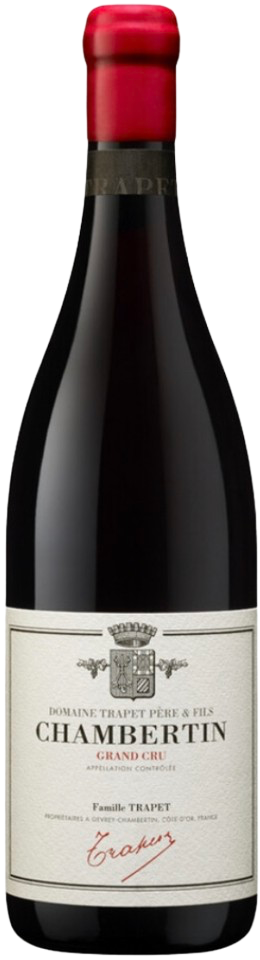
Chambertin wines on 1001caves
Detailed pages: the cuvée, the estate, the drinking window and the bottles for sale between collectors.