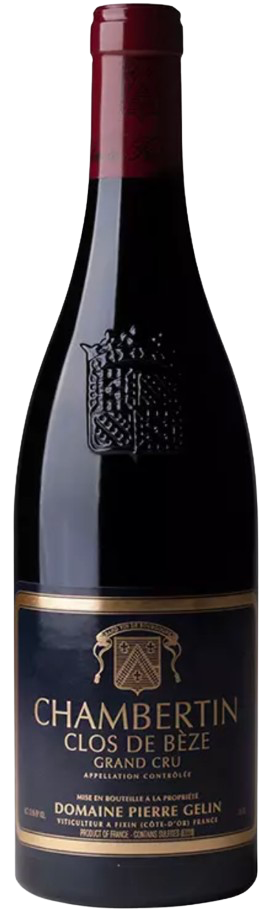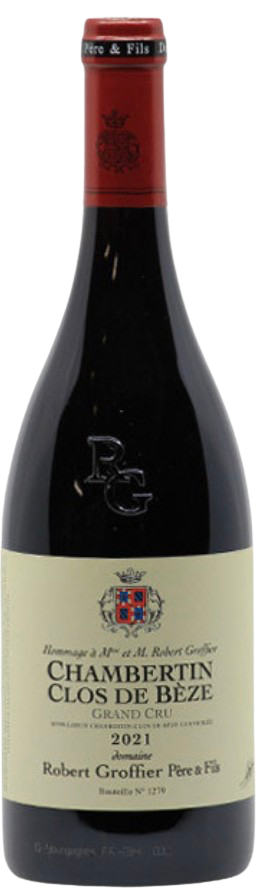
A Clos North of the Gevrey Grands Crus
The Clos de Bèze lies at the southern edge of the village of Gevrey-Chambertin, along the route des Grands Crus that runs towards Morey-Saint-Denis. It occupies the moderately inclined part of the hillside, facing due east, with the Mazis-Chambertin as its immediate neighbour to the north and the Chambertin to the south. The commune's nine grands crus are tiered between roughly 240 and 280 metres in altitude according to the BIVB, on what the trade body describes as "a cinemascope screen" facing the rising sun — the northernmost section of the grands crus of the Côte.
The appellation area covers only one lieu-dit, the "Clos de Bèze", and only one commune, Gevrey-Chambertin. The name has remained "clos" in local place-naming even though the walls disappeared long ago, and it is still linked to an abbey that has not owned it for eight centuries: the appellation rules themselves point out this persistence, a telling sign of the cru's antiquity.
The Terroir: The Bajocian Marl-and-Limestone Shelf
The geology of the Clos de Bèze is that of its neighbour, give or take a few nuances of position. The Côte de Nuits forms here a straight, tectonic relief running north-south for some twenty-five kilometres, between the limestone plateaus of the Hautes Côtes to the west (400 to 500 m) and the plain of Bresse to the east (about 250 m). The delimited parcels lie at the foot of the slope, on a slight shelf. The lower, gently inclined part rests on a substrate of hard limestone, once quarried as dressed stone, capped by a level of marl — a clayey limestone — which can be picked out in the landscape by the slight concavity it traces beneath the main slope. The whole sequence dates from the Bajocian, Middle Jurassic, and the vines do not rise above the top of these marls.
The marl-and-limestone substrate is masked by a thin layer — a few decimetres to a metre — of spreads mixing scree with red clays and silts derived from the weathering of the subsoil and of the relief above. The BIVB describes the slope thus: a few tens of centimetres of brown earth, from silts and gravelly scree on the upper part, limestones of varying clay content on the slope itself, with the Bathonian capping the whole in the upper section above the marls and the crinoidal limestone of the Bajocian. Fossils outcrop, souvenirs of a sea a hundred and fifty million years old. The soils are little evolved, carbonate-rich, shallow, but free-draining despite a high clay content; the marl level feeds temporary water flows that make up for their small water reserves.
Climate, Exposure and Production Rules
The climate is cool oceanic, tempered by continental and southern influences carried up the Rhône-Saône corridor: around 750 millimetres of rain a year, evenly spread, with no pronounced summer drought, and an annual mean of 10.5°C. The Clos de Bèze rules explicitly mention a föhn effect: east of the Morvan and the Burgundian plateaus, the Côte enjoys a climatic shelter that gives it a thermal advantage and a rainfall deficit notable for the region. The topography protects the parcels from frost and morning fog, and the east-facing exposure warms the soil very quickly.
The production rules are those of the grands crus of the Côte: a minimum density of 9,000 vines per hectare, rows no more than 1.25 metres apart, a maximum of eight buds per vine, a maximum load of 8,000 kilos per hectare, no irrigation. The sugar content of the grapes may not be less than 198 grams per litre of must, for a minimum natural alcohol level of 11.5%. Continuous presses and wood chips are banned; ageing runs at least until 15 June of the year following the harvest and release to market comes no earlier than 30 June. The label may carry the words "grand cru" and the broader mention "Vin de Bourgogne", but naming the grape variety on it is forbidden.
The Style: The Nuance That Separates Bèze from Chambertin
The two crus adjoin and resemble one another: an intense, deep red with violet glints in youth, a nose of red fruit (raspberry, redcurrant) and black fruit (blackcurrant) mingled with rose, violet, undergrowth, liquorice and spice. On the palate, the concentration gives that sense of power, balance and harmony; the attack is lively, the finish combines unctuousness and elegance. The appellation rules sum up the cru's cardinal quality in three words: "very great longevity".
The nuance that tradition holds to is one of texture rather than power: where the Chambertin stands out for its robustness, the Clos de Bèze is held to be more delicate, more complex, more singular — combining finesse with power, firmness with grace. Many observers also judge its quality to be more consistent from one estate to another. At table, the grands crus of Gevrey call for dishes on their scale: furred game grilled or in a wine sauce, leg of lamb, bœuf bourguignon, coq au vin, powerful cheeses such as époisses. The BIVB recommends 12 to 14°C for a young wine, 15 to 16°C for a more mature one.
The Regulatory Point: Why Bèze May Call Itself Chambertin
This is the appellation's singularity, and it is thoroughly documented. Aware of the need to defend their production, the growers formed a syndicate in 1929 around the name "Chambertin", to which the Clos de Bèze was attached. In 1931, a ruling authorised the name "Clos de Bèze-Chambertin" for wines from the parcels of the lieu-dit. In 1932, a further ruling authorised the growers working those parcels to sell their wines under the name "Chambertin-Clos de Bèze" or under the name "Chambertin", fixing at the same stroke the cru's definitive boundaries. The AOC was recognised by decree in 1937.
That option is written into the Chambertin rules, whose delimited area "corresponds to the two lieux-dits 'Chambertin' and 'Clos de Bèze'". The reverse does not exist: no wine born on the lieu-dit Chambertin may claim the Chambertin-Clos de Bèze appellation. In practice, the owners of the clos rarely use the right, the reputation of the Clos de Bèze being at least equal to that of its neighbour — but they retain the possibility of switching. None of the seven other grands crus of Gevrey enjoys an equivalent privilege, apart from the comparable mechanism that links Mazoyères-Chambertin to Charmes-Chambertin.
Fourteen Hundred Years of Land History
The story begins with a royal reward. In 628, the Merovingian king Dagobert I granted the land of Fons Besua to Duke Amalgaire; he had the abbey of Bèze built there and endowed it in turn with a considerable wine estate in the Côte-d'Or. The monks created the clos in the 7th century on their holding at Gevrey. In 1219, short of money, they sold it to the dean and chapter of Langres for six hundred livres estevenantes — the deed, preserved in the departmental archives of the Côte-d'Or, mentions neither area nor boundaries, so the original clos remains impossible to locate exactly. The Chapter patiently enlarged its holding through the 13th and 14th centuries, and probably already owned the neighbouring Chambertin: the two crus then formed a single landholding, worked by various growers.
From 1730, the merchant Jobert gradually acquired the working of the vines, became sole owner and renamed himself Jobert de Chambertin; the dynasty soon died out and the estate was confiscated at the Revolution, auctioned off and then broken up. The cru went on to endure the scourges of the 19th century — grape moth, powdery mildew, downy mildew, phylloxera — before the appellation d'origine contrôlée movement bore fruit in 1937. Its reputation, though, was already made: in 1816, Jullien drew no distinction between the Clos de Bèze and the Chambertin and placed both in the first class of the fine wines of Burgundy; in 1855, Jules Lavalle ranked it as "tête de cuvée, cru hors ligne, vin extra" and added that "it possesses to the highest degree all the qualities that make up the perfect wine: body, colour, bouquet, finesse".
The grape varieties of Chambertin-Clos de Bèze
Chambertin-Clos de Bèze wines on 1001caves
Detailed pages: the cuvée, the estate, the drinking window and the bottles for sale between collectors.