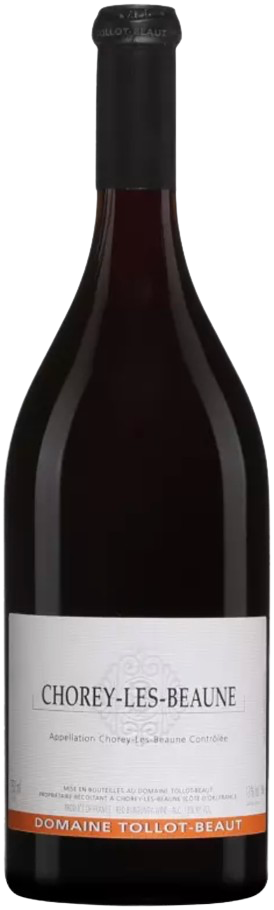
A Village of the Flat Land Between Corton and Beaune
Chorey-lès-Beaune occupies, in the Côte-d'Or, the strip of land that separates the Corton hill from the town of Beaune. Unlike its neighbours, the commune has virtually no hillside: its vineyard spreads across the footslope, at low altitude, on either side of the axis that runs along the Côte. Aloxe-Corton borders it to the north, Savigny-lès-Beaune to the west, Beaune to the south.
That geography explains everything else. In Burgundy, the hierarchy of appellations follows the gradient: grands crus and premiers crus on the best-exposed parts of the slope, village level below, regional appellations out on the plain. Chorey sits precisely on the hinge — high enough to deserve a village appellation, too low to lay claim to premier cru. It is the only village appellation in the sector in that position, and far from a handicap to be disguised, it is its identity.
The Terroir: The Alluvium of the Footslope
The soil at Chorey is clay-limestone, mixed with marly-limestone alluvium, over a sandy base. Nothing, then, to do with the hard limestones and in-place marls that make the grands crus a few hundred metres higher up: here, the material has been transported. It is the waters running down from the Côte that, over the millennia, spread these fans of deposits at the mouths of the combes, mixing clays, limestone debris and sand.
A footslope soil is deeper, cooler and more fertile than a hillside soil. The vine easily finds water there, grows more vigorously, and produces bigger, less concentrated berries: the recipe for a wine of fruit rather than a wine for cellaring. Add to that a flat exposure, without the slope effect that warms and drains a hillside, and a greater sensitivity to spring frost, since cold air pools in the low points. Quality here is therefore a matter of work: controlling yields, the age of the vines, selection at harvest.
Climate: The Common Regime of the Côte-d'Or
The climate is temperate with a slight continental tendency: rainfall spread through the year, fairly cold winters, hot summers sometimes crossed by storms. The climate readings for Dijon, at 316 metres, traditionally serve as the sector's reference. Pinot noir and chardonnay ripen early in the season here, and recent warming has brought forward every stage of the cycle: in 2003, some estates began harvesting as early as mid-August, an earliness that, according to the archives, had not occurred since 1422 and 1865.
On a terroir of flat land, that warming has its upside. Hot vintages, which sometimes make hillside wines too powerful, actually benefit the cool, deep soils of Chorey: they ripen more fully grapes that in the past could remain green. Part of the rise in quality seen in the appellation over the past twenty years is down to this climatic shift as much as to technical progress.
The Style of the Wines: Suppleness Embraced
Red chorey-lès-beaune is a light, supple wine, with a nose frankly dominated by red fruit, and little tannin. It seeks neither the power of Aloxe-Corton nor the backbone of the Savigny premiers crus: it offers the fruit of pinot noir without the wait. It is a wine you can open young, served cool, and it goes as happily with charcuterie as with poultry or a bistro dish. The wines are aged for twelve to twenty-four months before bottling.
White remains confidential — five hectares, 240 hectolitres — but it makes good use of chardonnay's potential, its berries able to reach fine sugar levels here while keeping their acidity. This marginal production is largely the business of estates that make it for their own pleasure or to round out their range. The heart of the appellation, with 131 hectares out of 134 and 5,820 hectolitres a year, remains red.
No Premier Cru: What That Really Means
The absence of premier cru is not an oversight in the classification, it is the logical consequence of the terrain: no climat at Chorey occupies the well-exposed hillside position that would justify the designation. Where Savigny-lès-Beaune lines up twenty-two premiers crus and Aloxe-Corton fifteen, Chorey claims none — and is not seeking any. Its wines may, like those of the other villages of the Côte de Beaune, be claimed under the côte-de-beaune-villages appellation.
That absence has a happy practical consequence for the wine lover: the price level. In a sector where the slightest label bearing the word Corton reaches the heights, Chorey has remained affordable. Many respected estates from Aloxe-Corton, Savigny or Beaune own parcels here and apply exactly the same work as elsewhere — same growers, same cellar, same ageing, but without the premium of classification. That is what makes the appellation an ideal way into the reds of the Côte de Beaune.
A Ducal Vineyard, a Recent Appellation
The history of the place is nonetheless an old one. The Chorey-lès-Beaune vineyard is said to have been founded in 1237 by Édouard de Froment, nephew by marriage of the Duke of Burgundy — a seigneurial origin still echoed in the château that overlooks the village. As everywhere on the Côte, the great milestones of Burgundian wine history were played out here: the banning of gamay in favour of pinot noir decreed by Philippe le Hardi in 1395, the edict of Charles VI in 1416 setting production limits, then the scourges of the 19th century — grape moth, powdery mildew, downy mildew and phylloxera.
The name of Chorey, though, long remained invisible. For centuries the commune's wines were sold under the more marketable names of its neighbours, and it was only in 1970 that the vineyard obtained its own AOC — half a century after its neighbours on the slope. That late recognition partly explains the appellation's still discreet profile, and the fact that its production is still largely sold on by the Beaune négoce.
The grape varieties of Chorey-lès-Beaune
Chorey-lès-Beaune wines on 1001caves
Detailed pages: the cuvée, the estate, the drinking window and the bottles for sale between collectors.