A Regional Appellation on the Scale of the Whole Mâconnais
The Mâconnais hills stretch over some forty kilometres, from the Côte Chalonnaise in the north to the rock of Solutré in the south, between the Saône to the east and the Grosne to the west. It is there, in Saône-et-Loire, that the Mâcon AOC unfolds. The base area covers the communes of the arrondissement of Mâcon and eleven nearby communes; the whites make up the bulk of the vineyard, with 3,767.91 hectares in production in 2018, against 522.45 hectares for the reds and rosés.
In terms of the Burgundian classification, Mâcon is a regional appellation, in the same way as Bourgogne or Coteaux Bourguignons — and not a village like Pouilly-Fuissé or Viré-Clessé. But it escapes the usual logic of the regionals: where the others cover plots scattered across the whole of Burgundy, Mâcon maps out a coherent territory, with its own landforms, its galleried villages and its Romanesque bell towers. It is this ambiguity that makes its labelling so particular.
Mâcon, Mâcon-Villages, Mâcon + Commune Name: Reading the Label
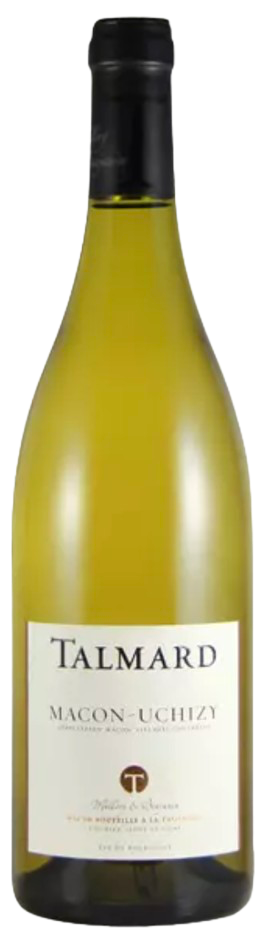
Three wordings coexist, and they do not mean the same thing. Plain "Mâcon" is the base level, open to all three colours; in white it accounts for only 77.64 hectares, but it makes up most of the reds and rosés (324.99 hectares). "Mâcon-Villages" is a wording strictly reserved for white wines, and therefore for chardonnay: it is the bulk of the vineyard, with 2,042.82 hectares and an average harvest of 127,610 hectolitres. Finally, "Mâcon" followed by a commune name — Mâcon-Lugny, Mâcon-Chardonnay, Mâcon-Loché, Mâcon-Péronne, Mâcon-Uchizy, Mâcon-Verzé and others — occupies 1,647.45 hectares in white and 197.46 hectares in red and rosé.
A crucial point: these denominations are not autonomous AOCs. They all come under the single cahier des charges of the Mâcon AOC, which delimits the eligible groupings of communes: 26 for the whites entitled to carry "Villages" or a commune name, 20 for the reds and rosés entitled to add a commune name. A bottle of Mâcon-Lugny is therefore not a "village" in the Burgundian sense of the word, but a mâcon carrying a more precise communal provenance. That is also why the name of the village of Chardonnay, the supposed cradle of the variety, appears as a denomination without constituting an appellation in itself.
The Terroir: Limestone Ridges, Rendzinas and Chailles
The Mâconnais hills form a set of ridges separated by parallel faults, running north / north-east to south / south-west. It is the flanks of these ridges that carry the vine, and the general orientation of the plots follows that grain. The geology is more varied than in the Côte: depending on the sector, mâcon is born on rendzinas, on brown limestone or calcic soils, or on siliceous, clayey and sandy ground.
This diversity reads directly in the choice of varieties. Rendzinas and brown limestone or calcic soils give the chardonnays for cellaring and suit pinot noir. Siliceous, clayey or sandy ground, often mixed with "chailles" — sandstone pebbles — favours on the contrary an earlier chardonnay; and towards the south, on the granitic soils that announce the neighbouring Beaujolais, it is gamay that naturally takes over. One and the same appellation, but a subsoil that changes every few kilometres.
Climate, Pruning and Work in the Vineyard
The Mâconnais enjoys a temperate climate with a slight continental tendency: moderately cold winters, hot summers, an often luminous late season. This is the most southerly part of Burgundy, which gives chardonnay riper fruit than at Chablis or in the Côte de Beaune, and allows gamay to ripen without difficulty.
Vine management follows a strong regional tradition: the "taille à queue du Mâconnais", derived from the guyot, in which the cane is bent into an arch. It counters the acrotony of chardonnay, which would otherwise tend to develop only its terminal buds, and offers partial protection against spring frosts — a real risk on so early a variety. Disbudding, wire-lifting and green harvesting complete a regime of yield control that has become the norm.
The Style of the Wines: Three Colours, One Same Fruit
White mâcon shows a robe from white gold to straw yellow, with silvery or greenish glints, and an immediately seductive aromatic register: broom, white rose, acacia, honeysuckle, fern, verbena, lemongrass, citrus, with shades of pine, quince and fennel on the finish. Dry but well fruited, fresh and easy-drinking, roundness and smoothness are its signature, with the acid support needed to hold it together. Serve it between 10 and 12°C, as an aperitif or with poultry, grilled fish, a creamy risotto or a goat cheese.
The reds range from cherry red to dark ruby, with the purplish glints typical of gamay. The nose marries small red and black fruits — redcurrant, bilberry — with undergrowth, mushroom and kernel; age draws them towards prune and pepper. A little hard in their youth, they soften and smooth out, and are served at around 14 to 15°C with fine charcuterie, rabbit or braised beef. The rosés, generous and lively, are drunk at around 11 to 12°C with charcuterie, a tagine or an onion tart.
Cluny, Lamartine and the Wine Cooperatives
The vine has been established here since Gallo-Roman times, but it owes its true medieval impetus to the powerful abbeys of Cluny and Tournus. The Mâconnais is also a literary land: Lamartine, a local son, born at Mâcon and attached to Milly, sang of these valleys — so much so that his commune today gives its name to a denomination, Mâcon-Milly-Lamartine. The appellations d'origine contrôlée of the Mâconnais were themselves instituted in 1937.
The Mâconnais is, finally, the cradle of the Burgundian cooperative movement. Most of its cooperative cellars were founded in the late 1920s and early 1930s, in the wake of the opening in 1925 of the one at Saint-Gengoux-de-Scissé. They still structure the appellation: the Cave de Lugny is the leading producer of Burgundy wine, and the cellars of Azé, Chaintré, Viré, Charnay-lès-Mâcon, Mancey and the Vignerons des Terres Secrètes at Prissé weigh heavily in the volumes. Alongside them work many family estates and merchant houses — Domaine Fichet at Igé, Domaine de la Sarazinière at Milly-Lamartine, Héritiers du Comte Lafon, Domaine de Chervin, Château de Nobles, Maison Trenel, Maison Louis Latour.
The grape varieties of Mâcon
Mâcon wines on 1001caves
Detailed pages: the cuvée, the estate, the drinking window and the bottles for sale between collectors.