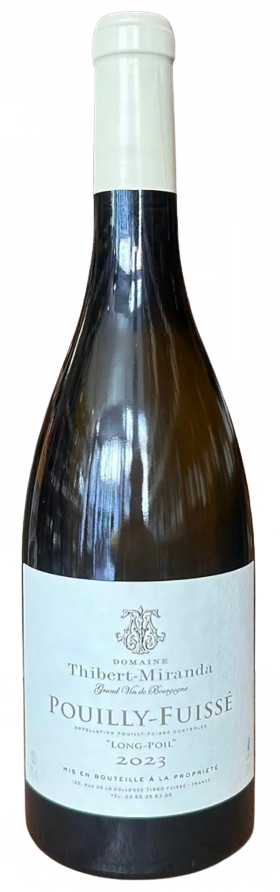
Four Communes at the Foot of the Solutré and Vergisson Rocks
Pouilly-Fuissé unfolds some ten kilometres west of Mâcon, in Saône-et-Loire, across four communes only: Chaintré, Fuissé, Solutré-Pouilly and Vergisson. This is the southern tip of the Burgundy vineyard, barely a few kilometres from Beaujolais, in a tumbled relief of combes, slopes and terraces that has nothing of the long, regular escarpment of the Côte-d'Or.
Two silhouettes command the whole landscape: the rock of Solutré and, facing it, the rock of Vergisson. These two limestone escarpments, shaped like the prow of a ship, structure the appellation, steer the winds, carve up the exposures and serve as a landmark for everyone crossing the vineyard. Solutré is also a major prehistoric site, excavated since the nineteenth century for its deposits of horse bones, and one of the most visited places in southern Burgundy. The area delimited in 1936 has never been extended since.
The Terroir: A Complete Jurassic, from the Lias to the Oxfordian
Pouilly-Fuissé's subsoil is mainly clay-limestone and belongs to the Jurassic of the Secondary era. The strata cover a range that is rare for so small an area: from the Lias, the oldest, to the Oxfordian, that is, rocks between 150 and 180 million years old. The rocks of Solutré and Vergisson form their framework — massive limestones, rich in marine organism debris, thrown into relief by the differential erosion that carried away the softer marls around them.
On the slopes, the vine works this layering: clayey marls at the foot of the slopes, stony scree and gryphaea or crinoidal limestones on the heights. A few sectors expose a crystalline, schistose or sandstone Primary basement, a legacy of the nearby Massif Central. This mosaic explains why chardonnay changes face from one parcel to the next: richer and fleshier on the deep clays, tauter and more saline on the stony limestones at the foot of the rocks.
Climate, Altitude and Exposures
The climate is temperate, with a slight continental tendency and a more marked southern influence than elsewhere in Burgundy: summers are hotter, ripeness comes more easily, which gives the wines their characteristic breadth. It is the exact counterpoint to Chablis, 250 kilometres to the north.
What offsets that warmth is altitude and relief. The vineyard is tiered from 225 metres up to more than 350, which is high for Burgundy, and exposures swing from east to south-west depending on the combes. The high parcels, backed against the rocks, are picked later and keep a precious acidity; the lower slopes, earlier, give roundness. Locally, growers use the "taille à queue du Mâconnais", derived from Guyot: this arched cane counters chardonnay's acrotony and delays budbreak, protecting the vine from spring frosts.
The Style of the Wines: The Broadest White in Southern Burgundy
Pouilly-Fuissé shows a clear, pale golden robe. The nose combines acacia flower, toasted almond and hazelnut, honey, and a mineral flint note that recalls the fossil-bearing sedimentary soils — ammonites, belemnites, gryphaea and crinoidal limestones. The palate is broader, more buttery and riper than that of a mâcon or a saint-véran, without losing the saline length that marks out great chardonnays.
Village cuvées drink happily between three and eight years. Premiers Crus, old vines and carefully oaked cuvées demand more patience and easily hold ten to fifteen years, developing notes of dried fruit, wax and fresh mushroom. At the table, it is the natural companion to the local cuisine: Bresse poultry, Dombes frogs, Saône fish, quenelles in sauce, gougères and Mâconnais goat's cheeses.
The 22 Premiers Crus of 2020, a First in the Mâconnais
The classification of Pouilly-Fuissé's Premiers Crus is the most significant event in the recent history of the Mâconnais. After more than ten years of investigation — study of soils, topography and history, mapping of the appellation's 217 lieux-dits, then parcel-by-parcel delimitation — the INAO approved the file on 3 September 2020; the amended cahier des charges was approved by order on 5 November 2020, applicable from the 2020 harvest. Twenty-two climats thereby gained the Premier Cru mention, covering 194 hectares, about 24% of the appellation's surface. No other Mâconnais appellation had ever obtained such an internal hierarchy.
The twenty-two climats are spread across the four communes: Le Clos de Monsieur Noly, Les Chevrières, Aux Quarts and Le Clos Reyssier at Chaintré; Le Clos, Les Brûlés, Les Ménétrières, Les Reisses, Les Vignes Blanches, Les Perrières and Vers Cras at Fuissé; La Frérie, Le Clos de Solutré, Au Vignerais, En Servy, Aux Bouthières, Aux Chailloux, Pouilly and Vers Cras at Solutré-Pouilly; Les Crays, La Maréchaude, Sur la Roche and En France at Vergisson. Vers Cras, straddling Fuissé and Solutré-Pouilly, is shared between two communes — hence twenty-three commune entries for twenty-two climats.
Worldwide Fame — and a Persistent Confusion with the Loire
Pouilly-Fuissé is one of the most exported Burgundian appellations, particularly to the United States, where its name long served as the gateway to white Burgundian chardonnay. A sign of its standing: since 1995 the Hospices de Beaune have owned four hectares in the appellation, the only cru located outside the Côte-d'Or to be auctioned at the famous sale on the third Sunday of November.
A word to clear up a frequent misunderstanding: Pouilly-Fuissé has nothing to do with Pouilly-Fumé or with Pouilly-sur-Loire. Those two appellations lie in the Loire, around Pouilly-sur-Loire in the Nièvre, and are based on sauvignon blanc (and chasselas for Pouilly-sur-Loire). The "Pouilly" of the Mâconnais, by contrast, is the hamlet of Pouilly in the commune of Solutré-Pouilly, and its variety is chardonnay, exclusively. Two terroirs, two varieties, two regions: only the shared name brings them together.
The grape varieties of Pouilly-Fuissé
Pouilly-Fuissé wines on 1001caves
Detailed pages: the cuvée, the estate, the drinking window and the bottles for sale between collectors.