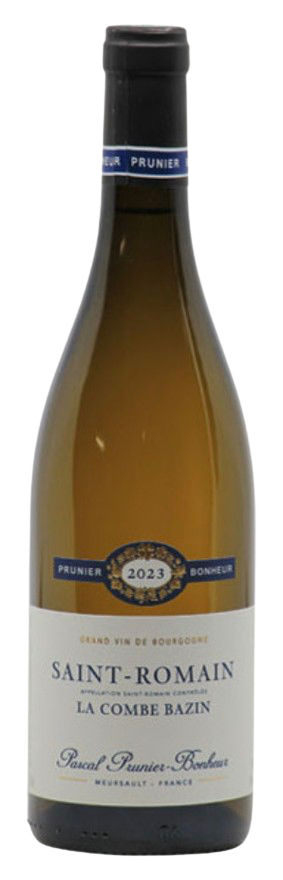
In the Back Slopes, an Appellation Set Apart from the Côte
The production area of saint-romain occupies part of the single commune of Saint-Romain, in the Côte-d'Or. The village lies three kilometres west of the Côte proper, in the back slopes, linked to the great hillside by the small valley occupied by Auxey-Duresses. You do not therefore pass Saint-Romain by chance: you have to leave the line of villages, climb a combe and enter a rocky cirque.
The appellation vineyard does not cover the whole of the commune's vines: it is confined to the valley lying east and south-east of the village. The other parcels produce bourgogne hautes-côtes-de-beaune, while the parcels ranked as saint-romain may also claim côte-de-beaune-villages and most of the regional appellations. That interlocking says much about Saint-Romain's frontier position, between the Côte and the Hautes Côtes.
The Terroir: Saint-Romain Marls, Plateau Limestones and a Fault
The geology of the commune reads like a cross-section. To the west, the capping of the plateau belongs to the Middle Jurassic: Prémeaux limestone, then white oolite and comblanchien, the whole Bathonian; the slopes descending towards the valley rest on Ostrea acuminata marls and Bajocian crinoidal limestone. Between the plateau and the village, the valley is cut into Pliensbachian marls, of the Lower Jurassic. A major fault, running north-north-east to south-south-west, crosses the commune and makes the rocks change abruptly from one bank to the other.
The appellation vineyard, for its part, sits almost entirely on one and the same subsoil: grey marls of the Upper Jurassic, made of limestone platelets mixed with clay, which geologists call precisely the "Saint-Romain marls". These are cool soils that hold water and delay ripeness — hence the taut profile of the wines. Above, to the east, the plateau ends in a well-marked cliff of Kimmeridgian limestone, and the château site occupies an outlier accompanied by tectonic slivers of Oxfordian limestone. Few villages on the Côte offer so complete a geological summary across so small a surface.
The Climate: Cold as a Signature
The Burgundian climate here is temperate oceanic with a slight continental tendency: rainfall spread across the whole year, changeable weather, and a wide monthly temperature range with cold winters and hot summers broken by storms. But Saint-Romain adds its own correction to that base: altitude and the enclosed nature of the cirque make this one of the coolest vineyards of the Côte de Beaune.
That thermal deficit was long a curse — the grapes struggled to ripen, and in the nineteenth century the back slopes fell back on gamay and everyday wines. The warming of recent decades has reversed the balance: ripeness is now reached without difficulty, and it is retained acidity that has become rare and precious. The cahier des charges remains demanding on must richness (a minimum of 178 g of sugar per litre in white, 180 in red), a threshold that growers now clear without trouble. Irrigation, for its part, is prohibited.
The Style: Straightness in White, Freshness in Red
The whites, which today make up two-thirds of production, have a golden robe with green glints and a classically floral nose — lime blossom, white flowers. The palate is mineral first, less broad and less intense than that of the great whites of the Côte de Beaune, but with a straightness and a clarity that make all their charm. They accompany pan-fried fish, marinated vegetables, œufs en meurette or cheeses that are not too assertive, served at around 12 to 14°C — not too cold, or the nose closes up.
The reds, a third of production, play on finesse: moderate colour, clear red fruit, discreet tannins, clean acidity. They are served between 13 and 15°C, never fully at room temperature. For wines of the Côte de Beaune, saint-romain drinks earlier than its neighbours: three to six years in the cellar are generally enough, the whites holding up to a good ten years and the reds a little longer depending on the vintage and the producer. Over the 2017-2021 period, production averaged 4,575 hectolitres, of which 3,039 in white, at modest actual yields — 42.8 hl/ha in white and 42.4 hl/ha in red, well below the permitted ceilings.
Late Recognition, and Still No Premier Cru
Saint-Romain took a long time to exist. In 1778, Abbé Courtépée already described a "wine country, whose best climats are below the Château & Poliange", but Jullien ignores it in 1816 and the 1861 classification explicitly leaves it out, on the grounds that its gamay vines did not deserve a place. In 1831, Denis Morelot recorded 150 hectares planted with gamay for 3,000 hectolitres a year. When the village appellations were created in the 1930s, Saint-Romain was not among them and its wines were sold under borrowed names from the Côte. The appellation was recognised only in 1947, with a yield then limited to 35 hl/ha.
The cahier des charges has been recast several times since: in 2011, maximum yields rose from 40 and 45 hl/ha to 50 in red and 57 in white; a new text was announced in December 2024 and published in February 2025 in the official bulletin of the Ministry of Agriculture. The creation of Premiers Crus is debated among producers and a classification file is under examination at the INAO, but no climat of Saint-Romain is Premier Cru to date: only the name of a registered lieu-dit may complete the label, in characters half the size.
The Best Value in the Côte de Beaune?
There is a cold indicator for placing an appellation: the official price of the 228-litre pièce used to calculate tenant farming rents. In 2024 it stood at 2,977 euros for white saint-romain and 2,212 euros for the red. By comparison, in the same year, white monthélie Premier Cru was at 3,167 euros, white saint-aubin Premier Cru at 4,076 euros, meursault village at 6,233 euros and meursault Premier Cru at 11,935 euros. A few kilometres apart, and on chardonnays from the same vineyard area, the gap is one to four.
That discount no longer reflects the quality of the wines but history: Saint-Romain has never had a Premier Cru to pull its name upwards. The BIVB counts 57 producers in the appellation, only six of them based in the village itself — the estates Alain Gras, Henri & Gilles Buisson, Germain Père et Fils, Barolet-Pernot Père et Fils, Thibault-Fevre and the house of Rapet Jean François. It is they who, in a single generation, have made this name a well-regarded way into the whites of the Côte de Beaune without breaking the bank.
The grape varieties of Saint-Romain
Saint-Romain wines on 1001caves
Detailed pages: the cuvée, the estate, the drinking window and the bottles for sale between collectors.