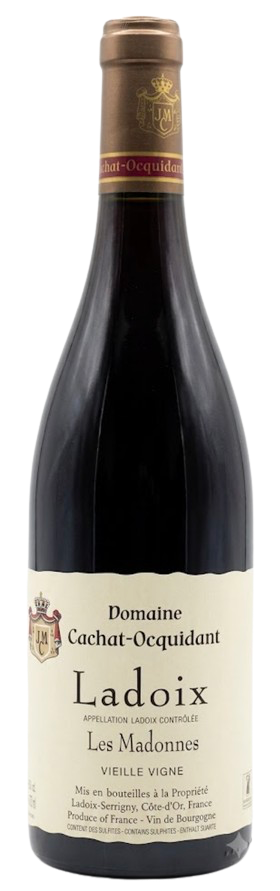
The Northern Gateway to the Côte de Beaune
The ladoix area occupies part of the commune of Ladoix-Serrigny, in the Côte-d'Or, 3.5 km from Beaune, on the route des Grands Crus. It is the last village appellation of the côte de Beaune before the côte de Nuits: Aloxe-Corton lies to the south-west and Corgoloin to the north-east. The whole village area unfolds on the slope, west of the D 974 — the old route nationale 74 — the piedmont vines to the east, around Serrigny, producing only regional appellations: bourgogne côte-d'or, coteaux-bourguignons and bourgogne aligoté.
The very name of the appellation tells a story of human geography. "Ladoix" is a hamlet tucked at the foot of Corton, born around the Lauve spring and then strung out as a street-village along the road; its name comes from the old French "la douix", the spring. Serrigny, further out on the plain, has nonetheless been the dominant settlement since the Middle Ages, with its thirteenth-century church and its eighteenth-century château. The hamlets were grouped together in 1988 to form the commune of Ladoix-Serrigny, but the appellation is called simply "ladoix": on the label, the wine carries the name of the hamlet, not that of the commune.
The Terroir: Reading the Corton Hill in Section
Few Burgundian communes offer so legible a geological section. At Ladoix, the subsoil literally changes with the slope, from the top of the hillside down to the road. Vines replace woodland from the crest, at around 350 metres, at the lieu-dit Sur les Gréchons: there reigns a thick formation (80 m) of grey-beige bioclastic limestones alternating in beds with marls, dated to the Middle Oxfordian. Just below outcrops a thin layer — one metre — of clayey limestone with ferruginous oolites, which mixes at the surface with colluvium and decalcification clay: this is the terroir of Les Gréchons and Foutrières.
Lower down, after grey and then yellowish Callovian marls, a powerful 25-metre layer, the "dalle nacrée" of the terminal Bathonian, forms a small cliff — its brown, red or purplish tint comes from the iron oxides it contains. It carries the climats of Le Rognet, Corton and Les Mourottes, and was so abundantly quarried that the lieu-dit Les Carrières still bears the name: until the nineteenth century Ladoix was better known for its veined stone than for its wine. At mid-slope comes the so-called "Comblanchien" limestone (Bathonian, 60 m thick, compact), covered by the pebbly silt of the Côte, rich in red, brown or grey clays: most of the classified climats are there. Finally, west of the hamlet of Buisson, the vines rest on the alluvial fan of the combes Jeannin and des Buis — limestone gravels held in a matrix of clay and sand, one to twenty metres thick, from the Pliocene to the Holocene.
Climate and Exposure: The Shelter of the Hill
The climate is that of all viticultural Burgundy: temperate oceanic with a slight continental tendency. The oceanic influence reads in frequent rainfall in every season — maximum in autumn, minimum in summer — and in changeable weather; the semi-continental influence in a marked thermal range, with colder winters and some snowfall, and hotter, sometimes stormy summers. The sector's reference weather station is that of Savigny-lès-Beaune, at 275 metres in altitude.
What sets Ladoix apart is its relief. The slope unrolls between the Corton hill and the bois de Mont on one side and the road in the valley bottom on the other: the top of the slope is stonier, the foot more clayey, and each level of the hillside gives a different wine profile. As everywhere in the Côte-d'Or, climate change is advancing the vine's cycle — budbreak, flowering, véraison — and therefore the harvest by a few days. Irrigation is forbidden by the cahier des charges.
The Style of the Wines: Two Colours in Almost Equal Shares
Ladoix is one of the rare village appellations of the côte de Beaune where white holds so large a place: a third of the area in 2022, against barely more than 20% in 2008. Over the 2017-2021 period, average annual production reached 4,421 hectolitres, of which 2,875 hl of red (65%) and 1,546 hl of white (35%), premiers crus included. Actual yields remain well below the ceilings: 40.7 hl/ha in red and 42.8 hl/ha in white, 36.8 hl/ha for the red premiers crus.
The reds show a ruby robe and a register that varies greatly with the climat and the grower: rather fruity (cherry, redcurrant, blackcurrant, strawberry) on the terroirs at the foot of the slope, rather sturdy — tannic austerity, power — on the high plots neighbouring corton; with age come sweet spices, liquorice, undergrowth and mushroom. Barrel ageing, from twelve to twenty-four months, adds woody and vanilla notes that ask for a little patience. The whites, golden in robe, play on white flowers (hawthorn, acacia) and yellow fruits, sometimes dominated by oak. The reds are served at 15-16°C, the whites at 11-12°C.
Eleven Premiers Crus, and the Sharing of Corton
Eleven climats are classified as premiers crus, and their distribution sums up the geography of the appellation. Five back onto the corton grand cru (Le Rognet et Corton, Hautes Mourottes, Basses Mourottes, Bois Roussot, Les Joyeuses), two crown the top of the slope (En Naget, Les Gréchons et Foutrières), four overlook the hamlet of Buisson (La Corvée, La Micaude, Le Clou d'Orge, Les Buis). Some are only partly classified — Hautes Mourottes, Les Joyeuses, Les Buis — which gives the measure of the fragmentation. In 2022 the premiers crus accounted for only 16.24 ha in red and 8.42 ha in white. Alongside them, a long list of unclassified climats may appear on the label, from Les Chaillots to La Toppe d'Avignon.
This fragmentation is the legacy of a battle. The Beaune merchant trade long sold these wines under more saleable names — "vin de Beaune", "d'Aloxe-Corton", "de Corton" — and in 1921 the Serrigny syndicat tried to have a "Ladoix-Corton" appellation recognised. Refusal came in 1923, then a long legal war with Aloxe-Corton: the Dijon court first granted the right to call the wine of 29 hectares corton, the court of appeal reduced that right to the single climat "Le Rognet et Corton", the Cour de cassation called the judgment into question, the Comité national des appellations d'origine found in favour of Aloxe-Corton — and it was not until 1954 that Serrigny obtained the extension of corton and corton-charlemagne onto a few of its climats. That is why, even today, the commune produces ladoix, corton, corton-charlemagne and even a few climats of aloxe-corton premier cru.
A Long-Ignored Vineyard, Rediscovered Today
Ladoix took a long time to exist under its own name. In 1728, the abbé Arnoux does not mention it in his Dissertation sur les vins de Bourgogne; in 1816, André Jullien likewise ignores it. In 1831, Doctor Morelot counted at Serrigny 157 hectares of gamay to only 47 hectares of pinot noir, when neighbouring Aloxe had already gone over to a single variety with 232 hectares of "noiriens". In 1861, the Plan statistique des vignobles classified only 25 hectares of Serrigny as "vines producing fine wines", ten of them in the first class on Les Vergennes, Le Roguet and Corton — today part of the corton grand cru.
The turning point dates from the post-phylloxera reconstruction: pinot noir supplanted gamay, the vines were planted in rows and trellised, and René Danguy noted as early as 1892 that "Ladoix-Serrigny has taken on real viticultural importance". The ladoix appellation was born with the wave of 1937 decrees that also created corton, corton-charlemagne and charlemagne; the premiers crus were instituted by a later decree. The commune hosted the Saint-Vincent tournante in 1984. An amusing sign of its acquired fame: an asteroid, (291847) Ladoix, bears the name of the village and of its wine.
The grape varieties of Ladoix
Ladoix wines on 1001caves
Detailed pages: the cuvée, the estate, the drinking window and the bottles for sale between collectors.