North of the Clos de Bèze, on the Same Slope
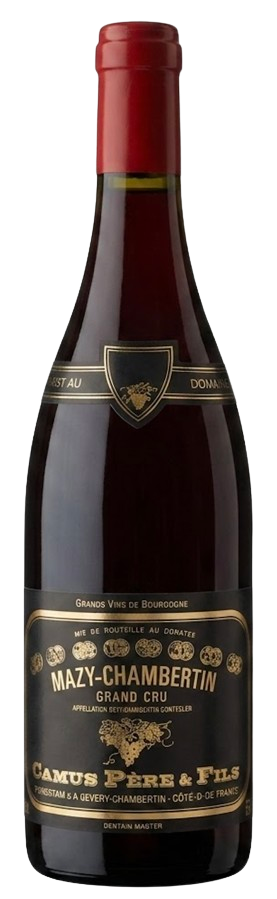
Mazis-Chambertin lies within the single commune of Gevrey-Chambertin, in the Côte-d'Or. It belongs to the group of grands crus that occupy the northernmost part of the great slope, that long east-facing screen which runs, between 240 and 280 metres in altitude, from Gevrey-Chambertin to Morey-Saint-Denis, between the combe de Lavaux and that of Morey. The cru extends the Chambertin-Clos de Bèze northwards and occupies the same slope: the Hospices de Beaune, who own a parcel there, describe theirs as lying "in the heart of the slope in the Mazis Hauts, on the same slope as the Chambertin Clos de Bèze".
The appellation has no climat ranked premier cru — everything there is grand cru — but it is divided into two internal lieux-dits of comparable size, Les Mazis-Hauts above and Les Mazis-Bas below. This duality is no anecdote: it matches a change of soil, it was recorded by the nineteenth-century classifications, and it continues to shape the way growers read the cru, some explicitly claiming the upper or lower origin of their vines. With its 8.73 hectares in production, Mazis is the fourth largest grand cru of Gevrey by area, behind Charmes, the Clos de Bèze and the Chambertin.
Mazis-Haut, Mazis-Bas: The Geological Reason
Here the Côte forms a simple relief: a well-marked east-facing slope, and the delimited parcels occupy the piedmont, on a slight shelf. The lower part, with little gradient, rests on a substrate of hard limestones, once quarried as building stone. These limestones are capped by a level of marl — clayey limestone — which reads in the landscape as a slight concavity, below the main face of the Côte. The whole is dated to the Bajocian, in the Middle Jurassic. The highest parcels, for their part, reach a level of frost-shattered Bathonian limestone: that is the concrete geological difference between the upper and lower parts of the climat.
Across the whole cru, the marl-limestone substrate is masked only by a thin layer, from a few decimetres to a metre, of spreads mixing scree with red clays and silts derived from the weathering of the subsoil and of the relief above — the Hospices describe their parcel in the Mazis-Hauts as "rich in a mixture of stones, scree and deep red clays". The soils are little evolved, generally carbonate-rich and shallow, free-draining despite a high clay content, particularly on the limestone substrate. The marl level is probably the source of temporary water supplies that compensate for the soil's low reserves, while the gradient carries off any excess. The upper ground, stonier and leaner, gives tauter and finer wines; the lower ground, more clayey and deeper, gives fleshier ones — exactly the hierarchy that Lavalle recorded in 1855.
Climate, Exposure and Production Rules
The climate is that of the Côte de Nuits: cool oceanic, tempered by continental or southern influences carried up the Rhône-Saône corridor. Rainfall is moderate and regular — around 750 millimetres a year — with no pronounced summer drought, for an annual mean temperature of 10.5°C. East of the Morvan massif and the Burgundian plateaus, the Côte enjoys a climatic shelter that gives it a thermal advantage and a notable rainfall deficit. The topographic situation of the parcels protects them from frost and from morning fog, while ensuring an easterly exposure very favourable to the rapid warming of the soil.
The rules are those of the grands crus of Gevrey: a minimum density of 9,000 vines per hectare, a maximum average load of 8,000 kilos per hectare, irrigation prohibited. The grapes are deemed ripe only from 198 grams of sugar per litre of must, for a minimum natural alcoholic strength of 11.5%; after enrichment — subtractive techniques are allowed within a concentration limit of 10% — the wines do not exceed 14.5%. The base yield is 45 hl/ha and the maximum yield 53 hl/ha, against 35 hl/ha in the original decree. The use of wood chips is prohibited, ageing runs at least until 15 June of the year following the harvest, and release to market takes place from 30 June. Indicating the grape variety on the label is prohibited; the name of the appellation may be followed by the mention "grand cru".
The Style: Power and Perfume
The robe is bright, a dark ruby. The nose combines red fruits — raspberry, blackcurrant, redcurrant — with liquorice, spice, rose and violet, then undergrowth with age. On the palate the wine is powerful, opulent, complex, voluptuous and elegant. The reputation of the cru was built on a seductive mixture of power and perfume: enthusiasts credit it with remarkable aromatic intensity, if not the absolute refinement of the two neighbouring Chambertins. It is a wine of generosity and length rather than restraint.
It keeps for ten to twenty years, longer in the great vintages. It is served between 13 and 16°C. At table the register is that of the grands crus of Gevrey: furred game grilled or in a wine sauce, lamb in sauce, coq au vin, glazed poultry, rib of beef, washed-rind cheeses. The difference in style between the upper and lower parts of the climat remains perceptible in tasting, but it is now often blurred by blending: most estates owning parcels in both lieux-dits vinify them together under the single name Mazis-Chambertin.
From Masures to Mazis: The Name and the Ranking
The etymology is domestic. The word "masure" describes a peasant house, and Burgundian dialect calls a small dwelling "mazoyères" or "mazis" — the same root that gave the neighbouring grand cru Mazoyères-Chambertin. One can go back further still, to the Latin "mas" that became "maison": the climat is said to preserve the memory of a group of buildings replaced by the vine. The spelling long fluctuated, and "Mazy-Chambertin" remains a permitted form.
The ranking came in stages. As early as 1774 the abbé Courtépée cited the "Mazy" among the renowned climats. Jullien, in 1816, placed the reds of the Mazis climat in the third class among the fine wines of Burgundy. Then came the most famous and most instructive judgment of all: in 1855, Dr Lavalle ranked the cru as "première cuvée for the upper part" and "deuxième cuvée for the lower" — the first written recognition of the Mazis-Hauts / Mazis-Bas divide. In the early twentieth century the wines of the Mazis were commonly sold under the name "Mazis-Chambertin" and the mention "grand cru" attached itself to them by usage; the judgment of the Dijon court in 1931 recognised that usage as an appellation d'origine and fixed its geographical limits. The AOC followed by the decree of 31 July 1937, amended in 1943 and then in 1964, the delimited area being revised by the INAO in 1984.
The Cuvée Madeleine Collignon and the Owners
Mazis-Chambertin is the only grand cru of the Côte de Nuits where the estate of the Hospices de Beaune owns vines, and there they are the leading owner. The parcel was given to them in 1976 by Jean Collignon, who asked that it bear the name of his mother, Madeleine. It lies in the heart of the slope, in the Mazis Hauts, on the same slope as the Chambertin-Clos de Bèze, and a substantial share of its planting still dates from 1947. The cuvée Madeleine Collignon is sold each autumn at the Hospices auction, then aged and bottled by the buyer — which explains why it is found under very different house labels from one vintage to the next. It is, in effect, the ambassador of the Côte de Nuits within an almost entirely Beaune-based hospital estate.
Around the Hospices, the cru has close to twenty owners — a fragmentation classic in Burgundy, but less extreme than in the grands crus of the lower slope. The house of Faiveley farms a long-held family holding in the Mazis-Hauts, while others, such as Dupont-Tisserandot, hold their vines in the Mazis-Bas; Domaine Henri Rebourseau, bought in 2018 by Martin and Olivier Bouygues, holds 0.96 hectare there, and Domaine Philippe Naddef is also present. This diversity of origins — upper or lower, old vines or recent plantings, Gevrey estates or Nuits houses — explains the sometimes considerable difference in style between two Mazis-Chambertin of the same vintage.
The grape varieties of Mazis-Chambertin
Mazis-Chambertin wines on 1001caves
Detailed pages: the cuvée, the estate, the drinking window and the bottles for sale between collectors.