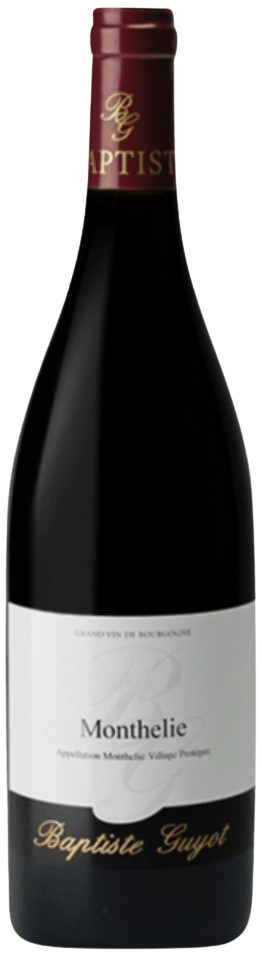
At the Mouth of the Combe, in Volnay's Shadow
Monthélie sits at the hinge between the Côte proper and the back slopes. The village backs onto the mouth of the combe that climbs towards Auxey-Duresses and then Saint-Romain, at the exact point where the continuous line of the great Côte de Beaune villages breaks to let a valley through. The vineyard is tiered from 230 to 370 metres in altitude, facing south and south-east, on slopes that are steep in places.
This position explains everything about the appellation, including its price. Monthélie's eastern parcels physically continue the Volnay slope: the same gradient, the same orientation, a few dozen metres of difference. But the commune boundary falls there, and the name with it. The vineyard covers only 123 hectares, against 213 at Volnay and 322 at Pommard: a small, discreet village, long regarded as a satellite of its prestigious neighbours.
The Terroir: Gravelly Bathonian Limestone and Red Clays
Monthélie's soils are calcareous and gravelly, developed on the Bathonian, with red clays and marls. This is slope terroir in the strict sense: the rock is close, the soil thin on the upper reaches, more clayey and more highly coloured where the marl levels come to the surface. The combe that cuts into the Côte at this point brings the layers back up and multiplies the configurations across a very small surface.
The difference in altitude — 140 metres between the bottom and the top of the vineyard — creates a clear internal hierarchy. The finest Premiers Crus, Sur la Velle, Les Champs Fulliots and Les Duresses, sit at mid-slope on well-drained gravelly limestone, in the continuation of the Volnay slope; the higher parcels, cooler and later-ripening, suit chardonnay better, which finds there the freshness it needs. This two-sided character explains the small production of white, under fourteen hectares, unusual among the immediate neighbours.
Climate and Exposure: The Freshness of the Back Slopes
The climate is temperate with a slight continental tendency, that of the whole Côte-d'Or. But the opening of the combe noticeably alters local conditions: air circulates more freely, nights are cooler, ripeness arrives a little later than at Volnay or Pommard. The high parcels, towards 370 metres, are distinctly ahead of the Côte average in freshness.
That slight lag is today less a handicap than an asset. In warm vintages it preserves acidity and perfume; it gives Monthélie's reds an aromatic definition — peony, violet, tangy red fruit — that earlier-ripening terroirs sometimes lose. The south to south-east exposure offsets the altitude and ensures full ripeness in most years.
The Style of the Wines: Firmness and Perfume
Monthélie red shows a ruby robe, with a nose of small red and black fruits — cherry, blackcurrant — floral notes of peony and violet, and a touch of undergrowth and fern. The palate is firm, finely tannic, with a velvety quality that arrives early: a wine built on structure rather than power, closer to the Volnay line than to Pommard's frame. It is served between 14 and 15°C, with roast poultry, lamb, rabbit or grilled andouillette, and keeps for eight to ten years.
The white, a rarity, plays on a golden robe and a register of white flowers — hawthorn — apple, hazelnut and vanilla, over a broad, mellow, gently tangy palate. Drunk at between three and five years and served at 11 to 12°C, it accompanies fish in sauce, prawns or blue cheeses. It is one of the least expensive expressions of Côte de Beaune chardonnay.
Sixteen Premiers Crus and Rare Value for Money
Monthélie has sixteen climats ranked Premier Cru: Sur la Velle, Les Champs Fulliots, Les Duresses, Le Meix Bataille, Le Clos Gauthey, Le Château Gaillard, Le Cas Rougeot, Les Vignes Rondes, La Taupine, Le Clou des Chênes, Les Riottes, Les Barbières, Les Clous, Les Hauts Brins, Clos des Toisières and Le Village. They account for 34.81 hectares in red and 1.80 hectare in white, a little over a quarter of the appellation — a noticeably lower proportion than at Beaune, Pommard or Volnay.
It is precisely this more modest ranking that makes Monthélie interesting for the wine lover. The village has never had the fame of its neighbours, nor the prices that go with it; yet on the same Bathonian formations and in the continuation of the same slope, it produces wines well above their reputation. The same reasoning applies to Auxey-Duresses, the other village of the combe: in the back slopes, the shadow cast by the great names amounts to a discount.
An Ancient Vineyard, Recognised Late
As everywhere on the Côte, the vine here predates any written trace of an appellation. Burgundy's great dates apply: the banning of gamay in favour of pinot noir by Philip the Bold in 1395, the edict of Charles VI setting the limits of Burgundy wine in 1416, then the scourges of the nineteenth century — grape moth, powdery mildew, downy mildew, phylloxera — which forced everything to be replanted on grafted rootstock.
The Monthélie appellation d'origine contrôlée was recognised in 1937, a year after those of Beaune, Pommard and Volnay. That slight administrative delay is telling: Monthélie was always seen as an adjunct to its neighbours, and part of its production could be sold under the côte-de-beaune-villages denomination. The village's rise in quality, driven by a new generation of growers, is one of the clearest movements in the Côte de Beaune since the 2000s.
The grape varieties of Monthélie
Monthélie wines on 1001caves
Detailed pages: the cuvée, the estate, the drinking window and the bottles for sale between collectors.