A Village Set Back, on Corton's Reverse Side
Pernand-Vergelesses lies in the Côte-d'Or, north of Beaune, at the northern end of the Côte de Beaune. Unlike its neighbours strung along the route des Grands Crus, the commune settled back from the line, in a fold of the relief, on the reverse side of the Corton hill. That out-of-the-way position explains a more discreet reputation — and long gentler prices — than those of Aloxe-Corton, only a few hundred metres away.
The compound name tells the same story as elsewhere in Burgundy: to "Pernand", the village name, the commune added "Vergelesses", that of its most celebrated climat. Les Vergelesses and above all Île des Vergelesses are among the most sought-after Premiers Crus of the Côte de Beaune. The commune also shares with Aloxe-Corton and Ladoix-Serrigny the Grands Crus corton, corton-charlemagne and charlemagne, and part of its territory produces aloxe-corton as well.
The Terroir: A Slope That Reads in Three Tiers
The vineyard is tiered between 250 and 300 metres in altitude, and the slope reads with remarkable clarity. On the upper slopes, marly soils dominate, brown and yellowish, cooler and richer in calcareous clay. At mid-slope come stony limestone soils, thin and free-draining. At the foot of the slope, finally, the soils are clay-limestone and deeper. This succession is no footnote: it governs how the two varieties are distributed across the commune.
The upper-slope marls are chardonnay's historic terroir — the same principle that, on the neighbouring flank of the hill, carries corton-charlemagne. The stony limestone soils of mid-slope give the finest climats, and the clay-limestone at the bottom offers pinot noir the matter and the depth of soil it needs. All of it belongs to the same Jurassic massif as Corton, whose Oxfordian layers form the framework and whose slopes, facing south-east to south-west between 250 and 330 metres, carry the largest Grand Cru of the Côte de Beaune.
Exposure and Climate: The Price of a Sheltered Position
The general climate is that of the Côte-d'Or: temperate, with a slight continental tendency, rainfall spread through the year, sharp winters and hot, sometimes stormy summers. The Dijon station, at 316 metres, serves as the sector's climatological reference. As everywhere, warming has advanced the vine's cycle: in 2003, some estates harvested as early as mid-August, a precocity unheard of since 1422 and 1865.
But at Pernand it is exposure that makes the difference. The village occupies a fold where the slopes do not all face the same way, and the sheltered parcels, cooler and often later, retain an acidity that the hill's due-south exposures lose more quickly. That is exactly what suits chardonnay, whose berries can reach high sugar levels here while keeping substantial acidity — the very definition of a balanced white. Conversely, these cooler exposures make Pernand's pinots less massive than those of Aloxe.
The Style of the Wines: The Whitest Commune on the Hill
With 78.42 hectares of chardonnay against 80.10 of pinot noir, Pernand-Vergelesses is the village appellation most evenly balanced between the two colours in the whole Corton sector — where Aloxe-Corton has only a hectare and a half of white. Annual production reaches 6,084 hectolitres, of which 3,321 hl of red and 2,763 hl of white. Premiers Crus weigh heavily on both sides: 43.10 ha in red and 40.17 ha in white, more than half the vineyard.
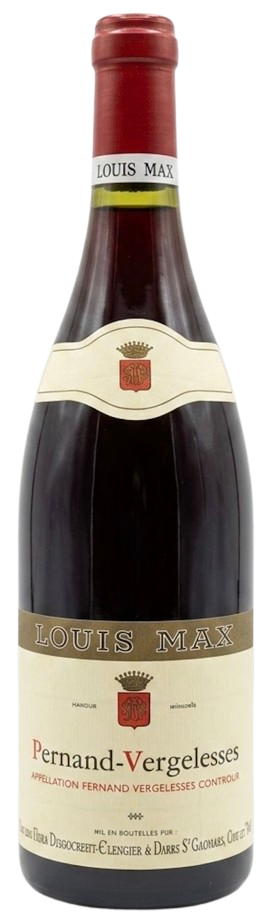
The whites show a golden robe and a nose of white flowers — hawthorn, acacia — honey and spice; the palate is brisk and dry, with the tension that makes them recognisable. They are served between 10 and 12°C and kept for three to eight years; they go readily with freshwater fish in a white sauce and with goat's or pressed cheeses. The reds display a deep ruby robe, a nose of strawberry, raspberry and violet, and a fleshy, full-bodied palate with melted tannins. Served between 14 and 16°C, kept for five to ten years, with classic table pairings: veal, leg of lamb, feathered game, Mont d'Or or reblochon.
The Premiers Crus: Île des Vergelesses and the Others
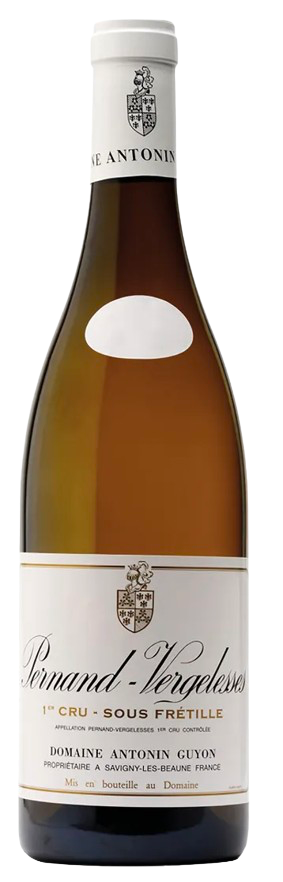
Unusually, Pernand-Vergelesses ranks Premiers Crus in both colours, and not always the same ones. In red, the ranked climats are Île des Vergelesses, Les Vergelesses, En Caradeux, Creux de la Net and Les Fichots. In white: Sous Frétille, Clos Berthet and Le Clos du Village. This double list is the cadastral translation of the slope's geology — the high marls to chardonnay, the limestone slopes to pinot noir.
Île des Vergelesses is the commune's flagship climat: a sloping parcel bordering Savigny-lès-Beaune, whose name evokes an island of vines isolated among waste ground. In white, Sous Frétille has established itself over recent decades as a benchmark, on the marly heights. Alongside the Premiers Crus, several village climats may appear on the label, such as La Morand, Les Plantes des Champs or Combottes.
A Village of Growers, in the Shadow of Corton-Charlemagne
Pernand-Vergelesses has remained a commune of family estates rather than large merchant houses. Among them are the estates Rapet Père et Fils, Dubreuil-Fontaine, Rollin Père et Fils, Marius Delarche, Pavelot Père et Fils and Denis Père et Fils — and Domaine Bonneau du Martray, whose vineyard is essentially set against the Grands Crus of the hill. Many of these houses make pernand-vergelesses at both village and Premier Cru level, as well as aloxe-corton and corton-charlemagne.
There lies the appellation's fertile ambiguity. Part of corton-charlemagne — the most famous white Grand Cru of the Côte de Beaune, backed by the tradition that Emperor Charlemagne gave a plot of vines on the hill in 775 — lies within Pernand's territory. The village therefore lives in the immediate shadow of a world-famous cru, which explains both the quality of its chardonnay and the fact that its own name long remained little known. For anyone seeking to understand — and to taste — the style of Corton's whites without paying the price, Pernand-Vergelesses is the way in.
The grape varieties of Pernand-Vergelesses
Pernand-Vergelesses wines on 1001caves
Detailed pages: the cuvée, the estate, the drinking window and the bottles for sale between collectors.