At the Southern End of the Côte de Beaune
Santenay is the last wine commune of the Côte-d'Or before Saône-et-Loire; the appellation in fact spills over onto part of the land of Remigny, already in Saône-et-Loire. To the north it continues Chassagne-Montrachet; to the south it hands over to the Maranges. It is here that the Côte de Beaune, having run more or less straight from Ladoix to Chassagne on a north-north-east to south-south-west axis, swings some twenty degrees towards the south: the whole orientation of the vineyard is altered.
The village itself is divided between Santenay-le-Bas and Santenay-le-Haut, overlooked by the mont de Sène — the "Mountain of the Three Crosses", 521 metres — which offers a panorama in every direction over the Côte de Beaune, the Saône valley, the Chalonnais and the Morvan, and where the remains of an ancient temple were excavated as early as 1872. To the south, the Dheune valley and the canal du Centre cut the corridor that physically separates the Côte de Beaune from the Côte Chalonnaise: Bouzeron and Rully, the first Chalonnais vineyards, are only a few kilometres away as the crow flies.
The Terroir: A Puzzle of Limestones and Marls, Cut Up by Faults
The geological study carried out on the vineyard by the ADAMA consultancy for the appellation's management body is unequivocal: Santenay and the Maranges are probably the vineyards of the Côte with the greatest variety of rock formations, both in age and in facies. Around ten formations, from the Lias to the Upper Jurassic, limestones and marls in roughly equal number, follow one another over short distances. The territory is also intensely fractured, and in the south-western sector the faults run mostly perpendicular to the slope — a singularity, whereas across the rest of the Côte the major faults tend to run parallel to the axis of the hillside.
This complexity stems from Santenay's hinge position, at the crossing of two geological histories: on the one hand the Oligocene collapse of the Bresse graben, which fractured and offset the limestone blocks of the whole Côte along a north-south axis; on the other the formation of the coal-bearing and Permian basin of Blanzy and Le Creusot, running north-east to south-west, which interrupts the Côte at this precise point. In detail, each group of climats has its own signature: the hard Nantoux limestone carries La Comme, Beauregard and the Clos des Mouches at mid-slope and produces a very visible break in gradient; below it, the Chagny marls, soft and more erodible, soften the slope beneath Les Gravières and the Clos de Tavannes; Beaurepaire and La Maladière rest in part on the Chassagne limestone, while a band of village climats, at around 220 metres in altitude, shows a striking uniformity of Dijon-Corton and Ladoix limestones.
The Combe Saint-Jean, the Exposures and the Climate
The combe Saint-Jean divides Santenay into two halves and organises the whole vineyard. On the northern slope, the drop reaches 150 metres, between about 215 and 350 metres in altitude; on the southern slope it is about 125 metres, between 240 and 365 metres. The highest planted point, around 400 metres, lies right at the top of the northern flank of the combe — high altitudes for the Côte, which explain part of the freshness of the wines. The Premiers Crus overwhelmingly face south-east; the village climats vary according to their position: south-east at the foot of the slope, south to south-east on the northern flank of the combe, due east on its southern flank.
The climate is temperate with a slight continental tendency, in the "Burgundy, Saône valley" climatic region characterised by good sunshine, of the order of 1,900 hours a year, and hot summers. The nearest weather station, at La Rochepot, records for 1991-2020 an annual mean of 10.6°C and 849.5 mm of rainfall. As everywhere on the Côte, the sensitivity of pinot noir and chardonnay to spring frosts remains the main threat, both varieties breaking bud early.
The Style of the Wines: The Frankness of Pinot Noir
Red dominates very largely, with close to six hectares in every seven. Santenay red shows a purple robe, with aromas of red fruit and flowers — peony, violet, rose petal. The palate is both deep and supple, firmly framed, with that slightly rustic frankness that long earned the appellation its reputation for pleasure at a fair price in the Côte de Beaune. It is served between 14 and 16°C with a rib of beef, poultry or small game; it keeps between five and ten years, up to fifteen in great vintages.
The whites, in the minority, account for a little under 48 hectares but deserve attention: a pale, bright colour, a nose of hazelnut and fern with mineral and floral notes, a fresh and vigorous palate. Served between 11 and 13°C, they accompany poultry in cream, fish, pasta and mountain cheeses, and are drunk within their first three to eight years. That balance — a great deal of red, a trickle of white — clearly distinguishes Santenay from its neighbour Chassagne-Montrachet.
The Climats Ranked Premier Cru
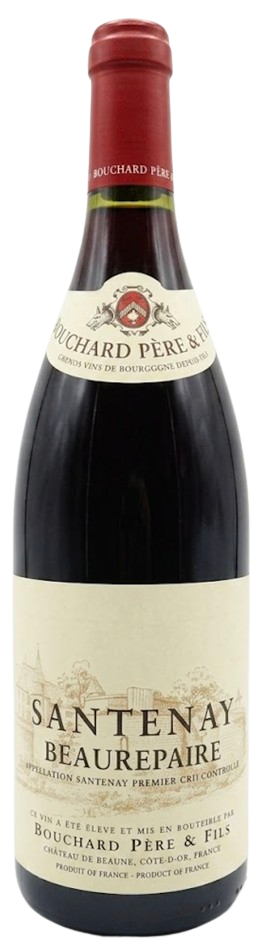
Recognised as an appellation d'origine contrôlée in 1937, Santenay has a series of climats ranked Premier Cru, accounting for close to 110 hectares in red and close to 13 hectares in white. The best known fall into two distinct groups. To the north-east, against the Chassagne boundary, the main cluster brings together Les Gravières, Clos de Tavannes, La Comme, Beauregard, Beaurepaire, La Maladière and Clos des Mouches. To the south-west, on the Maranges border, are Clos Rousseau and Grand Clos Rousseau.
The two groups do not tell the same geological story. The first plays on the contrast between the hard limestone above and the marls below; the second rests on the most complex set of faults ADAMA has mapped on the Côte, to the point that the Grand Clos Rousseau on its own contradicts the convenient idea of "one climat, one geological unit". That is also what makes Santenay such an absorbing place to taste: two neighbouring parcels here almost never say the same thing.
Wine and Water: Santenay-les-Bains
Santenay is one of the very few villages on the Côte to possess a second identity: that of a spa town. A mineral spring, the Fontaine Salée, has been known here since antiquity; rediscovered in the modern era, it gave rise in 1888 to a first establishment with a pump room and bottling plant, soon joined by a casino in 1892. In the absence of a protection perimeter, boreholes multiplied: the Lithium spring (1893 and 1899), the Carnot spring (1900 and 1904) and the Santana spring (1906) lined up their premises along what became the avenue des Sources, completed by the Kursaal (1895) and the Grand Hôtel des Bains (1903).
These waters owe nothing to chance: they rise along the network of faults that breaks up the commune's subsoil — the same fracturing that explains the mosaic of climats. Santenay's spa history has been eventful: the commune was struck off the list of spa towns in 1946, restored to it in 1963, classified as a hydrothermal and climatic resort in 1968, saw the activity cease in 1995, then a new thermal centre open in 2021. Wine and water, two readings of one and the same geological accident.
The grape varieties of Santenay
Santenay wines on 1001caves
Detailed pages: the cuvée, the estate, the drinking window and the bottles for sale between collectors.