Between Morey-Saint-Denis and Vougeot, on the Route des Grands Crus
Chambolle-Musigny occupies a stretch of the Côte de Nuits on the route des Grands Crus, 13 kilometres from Dijon and 4 kilometres from Nuits-Saint-Georges. The Morey-Saint-Denis vineyard borders it to the north, that of Vougeot to the south-east. The appellation area covered 152.99 hectares in 2018, of which 58.25 hectares classified premier cru: more than a third of the surface, one of the highest proportions on the Côte.
Average annual production is around 5,953 hectolitres across the 2014 to 2018 vintages, including 2,233 hectolitres of premier cru. The village owes its name to the Grône, an intermittent stream that bursts out of the combe after storms: Campus Ebolliens, the "boiling field", which became Cambola in the cartulary of the abbey of Cîteaux in 1110. This torrent has flooded the village several times, in 1744, 1803, 1816 and 1836, then again in 1900, 1979 and 1983.
The Terroir: Two Combes and a Staircase of Limestones
The appellation's vineyard is tiered between 253 metres, along the D974, and 348 metres at Les Véroilles; the commune itself drops from 441 metres in the forest to 240 metres out on the plain. The slope mostly faces east or south-east, warming the vines from first light — except in the two combes and on the climats immediately south of the village, curiously turned to the north-east. The mid-slope is cut into by the combe de Chambolle (combe Ambin) and, at its southern end, by the combe d'Orveaux: two cooler dry valleys whose mouths form alluvial fans. The beds were laid down in the Middle Jurassic, Bajocian and Bathonian; the relief was born far later, at the end of the Oligocene, with the collapse of the Bresse graben, a network of parallel and transverse faults cutting the slope into a mosaic of compartments.
The vertical reading is striking. The wooded summit rests on Comblanchien limestone, hard and cream-coloured, which outcrops as cliffs in the combes and which the faults bring back to the surface further south, beneath Musigny, the upper Amoureuses and Les Borniques. Next comes the white oolitic limestone, then the Prémeaux limestone, grey-beige and harder, which gives clayey, stony soils and scatters patches of siliceous chert lower down. The yellow-green marls with Ostrea acuminata cap the upper part of Bonnes-Mares and yield brown-yellow clay-silt soils; the crinoidal limestone, a massive ochre bed stained with iron oxides, gives the "red earths" of the lower Bonnes-Mares. At the mouths of the combes spread thick alluvia of Comblanchien pebbles; at the foot of the slope, a salmon-coloured Oligocene conglomerate; out on the plain, the very clayey grey-blue Bresse marls of the Pliocene. The mid-slope of the grands crus and premiers crus has thin, stony, perfectly free-draining soils — the village appellation occupies mainly the lower ground, where the soils deepen and grow richer in clay.
Climate: Oceanic with a Continental Tendency
The Burgundian climate is temperate oceanic with a slight continental tendency. The oceanic influence brings frequent rain in every season, with a peak in autumn and a low in summer, and changeable weather; the semi-continental note shows in a wide monthly temperature range, colder winters with occasional snowfall, and summers hotter than on the coast, punctuated by violent storms.
On the scale of the hillside, the general north-north-east / south-west orientation sets the slope facing the rising sun: the grapes catch the light early and dry quickly. The two combes, by contrast, create cooler corridors that temper the hot vintages. Climate warming can now be read in the dates: budbreak, flowering and véraison are all moving forward, and harvests are often several days earlier. The 2003 heatwave brought a harvest start date in Burgundy a month ahead of normal, an earliness not seen since 1420, 1523 and 1865.
The Style of the Wines and their Ageing
Chambolle-musigny shows a ruby to garnet robe, turning brick with age. The nose plays on fruit — blackcurrant, raspberry, black cherry, blackberry — and above all on the floral register, violet and dried roses, before evolving with age towards spiced fruit, prune, truffle and musk. It is traditionally presented as the most delicate and least tannic of the reds of the Côte de Nuits; André Jullien, in 1816, was already calling it "the Volnay of the côte de Nuits", with "a little more body" and "far more staying power".
Actual yields remain well below the regulatory ceiling: in 2022, 93.662 declared hectares produced 3,970 hectolitres, that is 42 hl/ha, against a base yield of 50 hl/ha. Most of the wines drink between three and fifteen years, with the youngest decanted; the best hold twenty years and more — 1990, 2005 and 2009 are the benchmarks. Serve between 13 and 15°C with refined cooking: game in sauce, bœuf bourguignon, Bresse poultry, mild cheeses or washed rinds from Époisses to L'Ami du Chambertin.
Musigny, Bonnes-Mares and the Twenty-Four Premiers Crus
The village appellation was born of the 1936 decree, the same one that created AOC Musigny; Bonnes-Mares was established in the same year, and the premiers crus by a later decree. These two grands crus are autonomous appellations, distinct from the village: Musigny occupies the south of the slope, hard against the Clos de Vougeot, on Comblanchien limestone and stratified scree; Bonnes-Mares holds the north and spills over into Morey-Saint-Denis. A grand cru wine that fails to meet the conditions of its appellation may be declassified to chambolle-musigny premier cru.
Among the twenty-four climats classified premier cru, Les Amoureuses, just below Musigny, count as an unofficial grand cru: in 2022, 4.435 hectares there produced 196.74 hectolitres. Les Charmes, larger, gave 364.75 from 8.76 hectares. Les Fuées, Les Cras, Les Sentiers, Les Baudes, Les Feusselottes, Les Gruenchers and Les Hauts-Doix complete the picture. A few climats are worked as monopoles, such as the premier cru Les Véroilles at Ghislaine Barthod or the Clos du Village at Antonin Guyon. The prestige can also be read in land prices: in 2015, the ouvrée of premier cru was valued at 55,000 euros — about 1.29 million euros a hectare — more expensive than any other village appellation of the Côte de Nuits apart from Vosne-Romanée.
The grape varieties of Chambolle-Musigny
Chambolle-Musigny wines on 1001caves
Detailed pages: the cuvée, the estate, the drinking window and the bottles for sale between collectors.
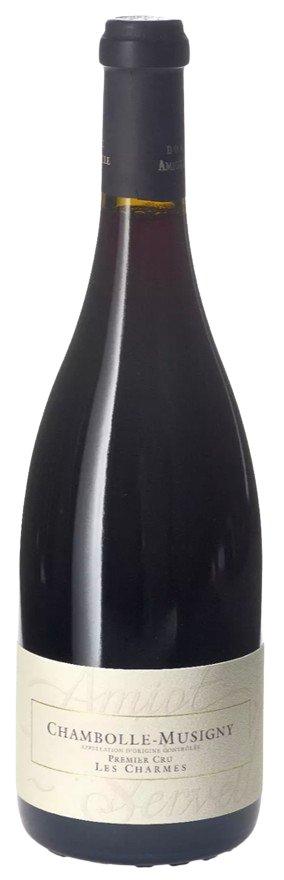 Amiot-Servelle - Chambolle-Musigny Premier Cru Les Charmes 20231er Cru · Chambolle-Musigny→
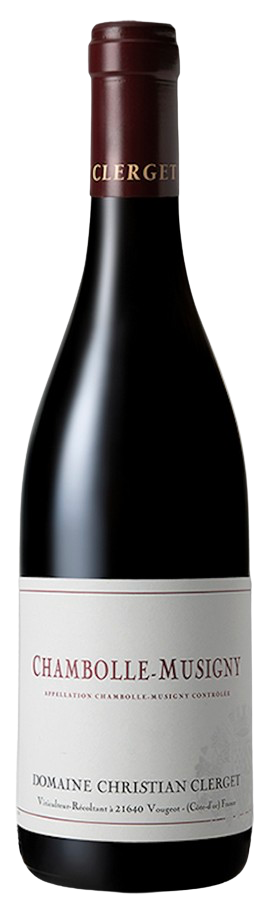 Domaine Christian Clerget - Chambolle-Musigny 1999Chambolle-Musigny→
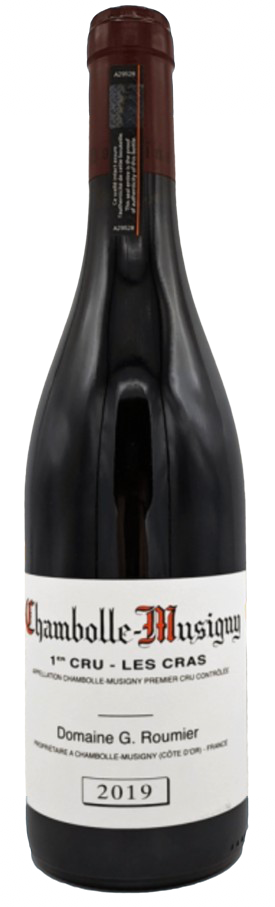 Domaine G. Roumier - Chambolle-Musigny Premier Cru - Les Cras 20061er Cru · Chambolle-Musigny Premier Cru→
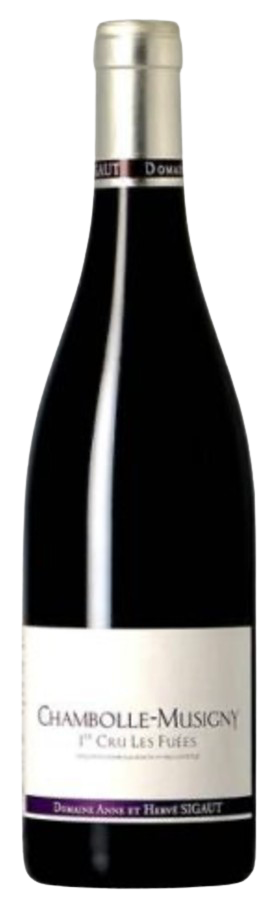 Sigaut 1er Cru Les Fuées 20231er Cru · Chambolle-Musigny→