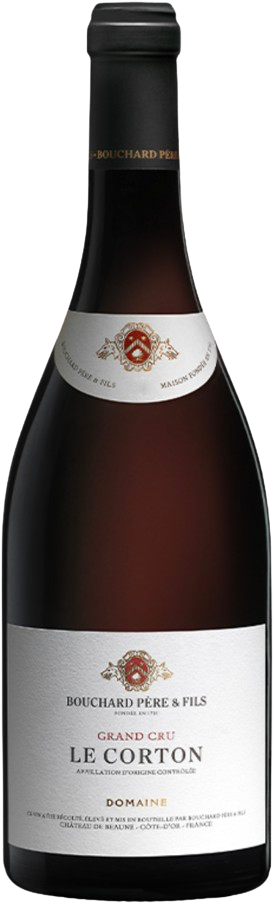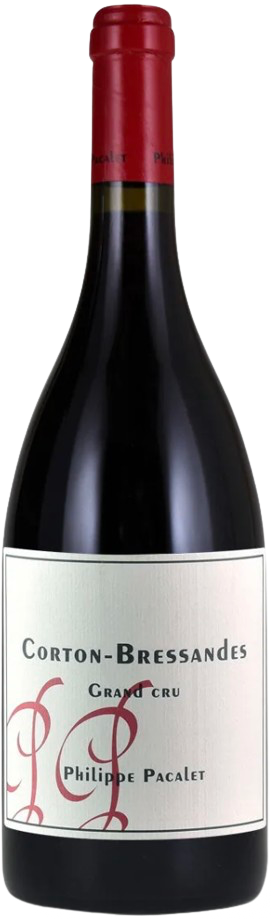
One Hill, Three Communes, a Single Grand Cru
The Corton hill rises north of Beaune like an isolated promontory, crowned by a wood that makes it recognisable from afar. Unlike most Burgundian grands crus, cut out within a single commune, the Corton appellation runs all around this relief and extends over the territory of three communes of the Côte-d'Or: Aloxe-Corton, Ladoix-Serrigny and Pernand-Vergelesses. The cahier des charges cites all three for harvesting, vinification, elaboration and ageing.
This deployment as a crown explains its size. With a little more than a hundred hectares as recorded by the BIVB and reproduced by Wikipedia — most of it in red, the white share not reaching three hectares — Corton is the largest of the grands crus of the Côte de Beaune. It is also the only one to produce red wine: everywhere else, from Montrachet to Charlemagne, the grands crus of this côte are whites.
The Terroir: Oxfordian, Marls and Reddish Gravels
The vineyard is tiered between 250 and 330 metres in altitude, on exposures that turn from south-east to south-west depending on where one stands on the crown. Wikipedia describes a vineyard formed of Oxfordian Jurassic layers, with a gently sloping reddish and stony soil, brown limestone, rich in marls with a high potash content. This ferruginous tint of the mid-slope soils is the visual signature of the best pinot noir parcels.
The hill therefore reads vertically as much as horizontally. The upper slopes, marlier and paler, are the domain of chardonnay — this is where the neighbouring Corton-Charlemagne appellation is played out. Below, on the brown and red gravels mixed with ferruginous oolith, pinot noir finds the drainage and the soil warmth that give it its density here. Domaine Faiveley thus describes its Clos des Cortons: a terroir dominated by limestone, marl and clay, scattered with ferruginous oolith. The cahier des charges moreover explicitly protects these soils by prohibiting any substantial alteration of the morphology, subsoil or topsoil of the parcels.
Climate and Vineyard Management
Corton has a temperate climate with a slight continental tendency, like the whole Côte-d'Or: pronounced winters, hot summers, decisive late seasons. On a hill shaped as a crown, exposure becomes the first factor of differentiation. Parcels facing south-east receive the morning sun and ripen early; the more westerly exposures, on the Pernand-Vergelesses side, gain in freshness and tension. This is one of the reasons why two neighbouring corton can have such dissimilar personalities.
The discipline of production is that of the Burgundian grands crus, and it is severe. Minimum density of 9,000 vines per hectare, spacing between rows capped at 1.25 metres, irrigation prohibited, continuous presses prohibited, use of wood chips prohibited. The base yield is set at 35 hectolitres per hectare in red and 40 in white, with maximum yields of 49 and 54 hectolitres. Ageing runs at least until 15 June of the year following the harvest, and the wines may not be released to market before the following 30 June.
The Style: The Most Sturdily Built Pinot Noir of the Côte de Beaune
Red corton stands apart from the usual gentleness of the Côte de Beaune. The robe is deep purple, almost dark velvet; the nose mixes black fruits and kirsch with notes of undergrowth, leather, pepper and liquorice; the palate is powerful, full-bodied, structured. It is a wine that demands time and calls for straightforward dishes — game, roast cuts of beef, intense cheeses — served between 14 and 16°C. The BIVB places its ageing between four and twelve years, a cautious range that the best climats far exceed: Domaine Faiveley announces ten to twenty-five years for its monopole.
White corton, for its part, remains a connoisseur's curiosity: only a few dozen hectolitres a year. Pale gold with mineral nuances, with aromas of cinnamon, honey and fern, supple and round but of fine breeding, it is served between 12 and 14°C with seafood, fish, poultry or a goat's cheese. Its rarity comes down to a simple economic trade-off: on a hill where chardonnay has its own grand cru appellation, few growers choose to make white as Corton.
The Climats: When the Name of the Lieu-Dit Completes the Appellation
This is the mechanism that makes Corton disconcerting. The cahier des charges provides that the name of the appellation "Corton" may be completed by the name of a climat of origin — but only for red wines, and only for the lieux-dits listed in the table appended to the cahier des charges. A wine from Les Bressandes is then labelled Corton-Bressandes; a wine from the Clos du Roi, Corton-Clos du Roi. A producer may also forgo the mention and blend several climats under the single name of Corton, or claim none at all. Hence the profusion of different labels for one and the same appellation.
At Aloxe-Corton, the list retained by the INAO includes in particular Les Pougets, Le Clos du Roi, Les Languettes, Les Bressandes, Le Corton, Les Paulands, Les Renardes, Les Maréchaudes, Les Grèves, Les Fiètres, Le Meix Lallemand, Clos des Meix, Les Combes, La Vigne au Saint, Les Chaumes, Les Chaumes et la Voierosse and Les Perrières. At Ladoix-Serrigny: Le Rognet et Corton, Les Moutottes, Les Carrières, Basses Mourottes, Hautes Mourottes, Les Vergennes, Les Grandes Lolières and La Toppe au Vert. These names, familiar to enthusiasts, designate sometimes minute parcels whose exposure and soil depth change everything.
History and Special Cases
The place is attested very early: Vineae de Cortun in 1212, Vinea de Corton in 1224, Clausus de Cortum in the thirteenth and fourteenth centuries. The etymology of the name remains obscure — neither Albert Dauzat nor Ernest Nègre pronounced on this micro-toponym, and the tradition that links Corton to a donation by Charlemagne on the lands of "Curtis Othoni" in 775 belongs to narrative rather than to demonstration. The appellation contrôlée, on the other hand, is dated with certainty: decree of 31 July 1937, in the first wave of AOC recognition.
One case deserves mention, because it is unique in Burgundy along with the Romanée-Conti: the Clos des Cortons Faiveley, a monopole held by the Faiveley family since 1874, is one of the two Burgundian grands crus whose name incorporates that of its owner. The estate explains that its family name was added to the original "Clos des Cortons" in the 1930s, at the end of a controversy, in order to remove any confusion. The estate stated 2 ha 76 a 52 ca (about 2.77 hectares) on the sheet published on its website (page updated in 2023), with plantings staggered from 1932 to 2019.
The grape varieties of Corton
Corton wines on 1001caves
Detailed pages: the cuvée, the estate, the drinking window and the bottles for sale between collectors.