The End of the Chambertin, on the Border with Morey
Latricières-Chambertin lies within the single commune of Gevrey-Chambertin, in the Côte-d'Or, on a single climat of the same name. It is the southernmost grand cru of the commune: to the north it touches the Chambertin, of which it is in reality only the topographic continuation, and to the south the premier cru Aux Combottes, beyond which Morey-Saint-Denis and its grand cru Clos de la Roche begin. To the west there are no more vines, only the woodland that covers the top of the Côte; to the east the parcel runs up against the climat of Les Mazoyères. The whole lies between 240 and 250 metres in altitude, facing east, on that long screen of hillside that the route des Grands Crus crosses from Gevrey to Morey.
The gradient here is particularly gentle: a slight movement from south to north as one goes up towards the Chambertin, another from west to east towards the route des Grands Crus. This near-flatness is rare among the grands crus of the Côte d'Or and it partly explains the reputation of the cru, long judged less "demonstrative" than its neighbours. It also explains a historical confusion: the wines of Latricières were sold under the name Chambertin until the middle of the nineteenth century, which is hardly surprising since the climat literally extends that of the king of Gevrey.
A Lean Soil, Hard Limestone and the Base of the Marls
The geological substrate combines hard limestones capped by a level of marl — clayey limestone — the whole dated to the Bajocian, in the Middle Jurassic; the Bathonian crowns the upper part of the slope, with the Bajocian marls and crinoidal limestone lower down. The particularity of Latricières is that the vines are planted mainly on the limestone level, where it reaches the base of the marls. This marl-limestone substrate is masked only by a thin layer, a few decimetres deep, of spreads mixing scree from the combe with red clays and silts derived from the weathering of the subsoil and of the relief above. On the upper ground the brown earth is made of silts and gravelly scree; on the slope it becomes charged with limestones of varying clay content, with fossils at the surface.
The soils are therefore little evolved, generally carbonate-rich, shallow and free-draining despite a high clay content, particularly on the limestone substrate. The marl level nonetheless plays a decisive role: it is probably the source of temporary water supplies that compensate for the soil's low reserves. This is exactly the paradox of the cru: a land reputed to be poor — the name "Latricières" is most often linked to "La Tricière", the lean land — yet a land that does not suffer from drought, because the underlying marl takes over the water supply at the moment when the fissured limestone no longer holds anything back.
The Combe de Grisard, or Why Latricières Harvests Last
The regional climate is that of the Côte de Nuits: cool oceanic, tempered by continental or southern influences carried up the Rhône-Saône corridor, with a moderate and regular rainfall pattern — around 750 millimetres a year — with no pronounced summer drought, and an annual mean temperature of 10.5°C. East of the Morvan and the Burgundian plateaus, the Côte enjoys a climatic shelter that gives it a thermal advantage and a notable rainfall deficit; the topographic position of the parcels protects them from frost and morning fog, while ensuring an easterly exposure favourable to the rapid warming of the soil.
Against this common background, Latricières is the exception. The Combe de Grisard cuts into the slope at right angles, roughly in the middle of the climat — it is barely visible from the vines, screened by trees — and it channels downwards a current of cold air that sweeps across Latricières before continuing over the Chambertin. The result is measurable in the calendar: Latricières is the coolest of the grands crus of Gevrey, and its producers unanimously observe that the harvest arrives distinctly later there than elsewhere. Long regarded as a handicap — a "green" cru in difficult years — this coolness is now read as an asset as the climate warms. The regulatory framework is that of the grands crus of Gevrey: a minimum density of 9,000 vines per hectare, a maximum load of 8,000 kilos per hectare, irrigation prohibited, a minimum ripeness of 198 grams of sugar per litre of must for a natural alcoholic strength of 11.5% and a maximum of 14.5% after enrichment, base yield 45 hl/ha and maximum yield 53 hl/ha — against 35 hl/ha in the original decree.
The Style: The Structure of the Chambertin, Without Its Weight
The robe is bright, from dark ruby to black cherry. The nose belongs to the family — raspberry, blackcurrant, redcurrant, kernel, liquorice, spice, rose and violet — before moving towards moss, undergrowth, earth and truffle. On the palate, power, opulence and elegance make up a full body, full of sap, built for at least ten years of ageing. Of all the grands crus of Gevrey, Latricières is one of the closest to the Chambertin in the finesse of its structure and the early opening of its complexity; what it lacks are the deeper notes, the impact and the bass density of its great neighbour. Less tannic than many wines of the Chambertin family in youth, it develops over time a very recognisable register of earth, humus and truffle.
The cru has long divided opinion. Clive Coates held it to be "a second-division grand cru", robust in youth, spicy and gamey at maturity, lacking both the distinction of the Chambertin and the finesse of Mazis and Ruchottes. Frank Schoonmaker, by contrast, wrote in 1964 that after the Chambertin and the Clos de Bèze it was "one of the best of that extraordinary little district". The growers themselves speak of definition, precision, wisdom and a fine line rather than power. It keeps for ten to twenty years, longer in the great vintages; it is served at around 12 to 14°C when young, 15 to 16°C when mature. At table: game — grilled or in a wine sauce — mushrooms, hare, lamb in sauce, rib of beef and washed-rind cheeses.
Petite Merveille, Attricières, La Tricière: The Story of a Name
The first mentions of the word "Latricières" date from around 1507-1508, and the delimited parcels have always corresponded to the heart of the lieu-dit, extending the Chambertin to the south. A document from after the Revolution, dated 1794, gives a variant: "Aux Attricières". The climat is said to have borne the nickname "Petite Merveille" in the Middle Ages. As for the origin of the name, the most widespread explanation links it to "La Tricière", that is, the poor land — a reading consistent with the proven leanness of the soil. Laurent Ponsot, whose family estate farmed the northernmost 0.75 hectare of the climat between 1960 and the mid-1990s, disputes this version and proposes a Celtic root designating the great oak that marked, replanted from generation to generation, the boundary between Latricières and Chambertin.
The ranking, for its part, came in stages. Jules Lavalle in 1855 placed the wines of Latricières in the deuxième cuvée, and recorded only three owners — Gournot, Ouvrard and Marion. Danguy and Aubertin, in 1892, maintained the rank but already counted six. In 1928 Morton Shand recognised only two têtes de cuvée at Gevrey, the Chambertin and the Clos de Bèze, and promoted Latricières to première cuvée alongside Saint-Jacques, Les Charmes, La Chapelle, Les Ruchottes, Les Varoilles and Mazis. In the meantime, commercial usage had gone ahead: in the early twentieth century the wines of Latricières were commonly sold under the name "Latricières-Chambertin", a usage that the judgment of the Dijon court in 1931 recognised as an appellation d'origine while fixing its geographical limits. The AOC followed, by the decree of 31 July 1937.
Twelve Growers, Two Founding Families
Present-day ownership descends from a simple post-revolutionary division: the Savot family to the south, the Riembault family to the north. The Savot vines passed in 1904 to the Camus and Trapet families, who still hold them — the Trapet parcels having since been divided between Domaine Trapet and Domaine Rossignol-Trapet. The Riembaults, who became by marriage the Remy family, on the contrary sold their share in several lots: Domaine Chantal Remy, at Morey-Saint-Denis, keeps only a strip of 0.28 hectare, the rest having given rise to the holdings of Leroy, of François Feuillet (farmed by David Duband), of Duroché and of Launay-Horiot.
As recorded in 2018, twelve growers share the climat: Domaine Camus, of Gevrey, with 1.51 hectares, the house of Faiveley at Nuits-Saint-Georges with 1.21, Domaine Trapet (0.75), Domaine Rossignol-Trapet (0.73), Drouhin-Laroze (0.67), Domaine Leroy (0.57), Arnoux-Lachaux (0.53), Domaine Simon Bize at Savigny (0.33), François Feuillet / David Duband (0.31), Chantal Remy (0.28), Duroché (0.25) and Launay-Horiot (0.17). Among the grands crus of Gevrey, only Griotte-Chambertin has fewer hands. The merchant houses are present only at the margins, essentially through the grapes of Domaine Camus, which explains a few well-known labels in an appellation where almost all the volume is bottled at the estate.
The grape varieties of Latricières-Chambertin
Latricières-Chambertin wines on 1001caves
Detailed pages: the cuvée, the estate, the drinking window and the bottles for sale between collectors.
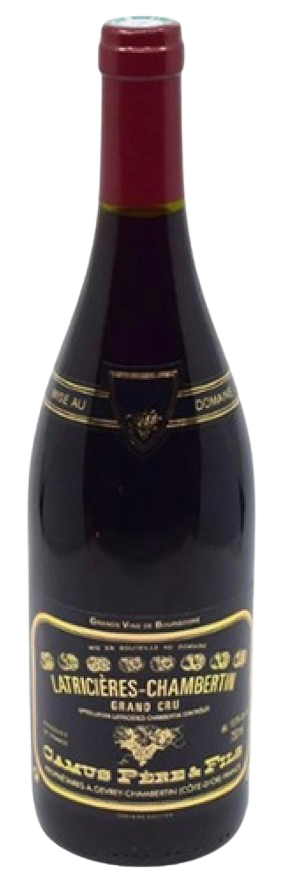 Camus Père et Fils - Latricières-Chambertin Grand Cru 2011Grand Cru · Latricières-Chambertin→
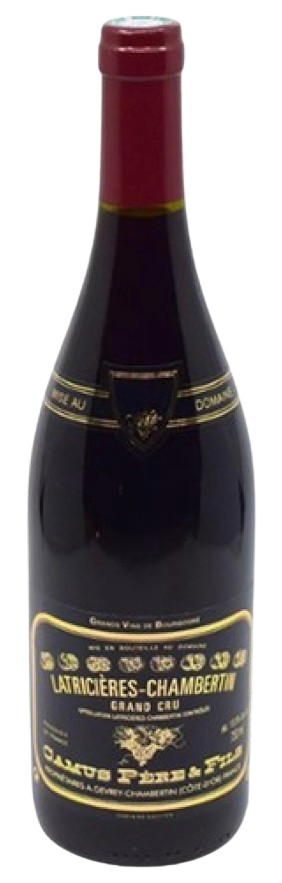 Camus Père et Fils - Latricières-Chambertin 2013Grand Cru · Latricières-Chambertin→Camus Père et Fils - Latricières-Chambertin 2014Grand Cru · Latricières-Chambertin→Camus Père et Fils - Latricières-Chambertin Grand Cru 2016Grand Cru · Latricières-Chambertin→
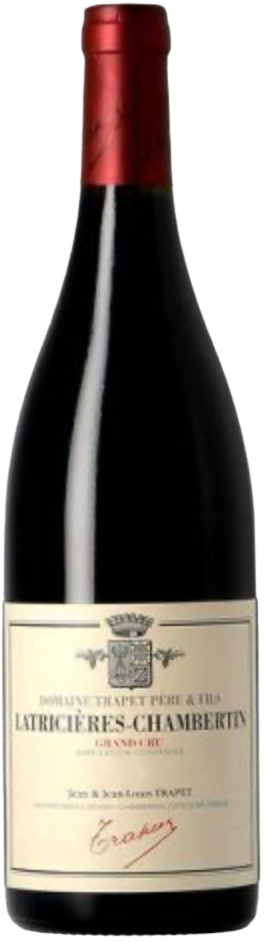 Domaine Trapet - Latricieres-Chambertin Grand Cru 2018Grand Cru · Latricieres-Chambertin Grand Cru,→