Aloxe, the Village at the Foot of the Cru
The aloxe-corton area unfolds in the Côte-d'Or, just north of Beaune, across three neighbouring communes: Aloxe-Corton, of course, but also Ladoix-Serrigny and Pernand-Vergelesses. It is a typically Burgundian arrangement, in which the appellation follows the terroir rather than administrative boundaries. The vineyard occupies slopes between 200 and 300 metres in altitude, at the foot and along the flanks of the Corton hill.
The name says everything about the hierarchy. "Aloxe" — pronounced "Alosse", as in Auxerre or Bruxelles — is the village's old name; "Corton" is the name of the hill, whose finest slopes carry the grands crus corton, corton-charlemagne and charlemagne. The village obtained the right to attach the cru's name to its own, a privilege denied to its neighbours: in 1923, Serrigny's request to become "Ladoix-Corton" was rejected, opening a long legal battle that the Corton growers' syndicate, chaired by Louis Latour, eventually won. Aloxe thus remained the historic and symbolic heart of the hill.
The Terroir: Siliceous Nodules and Flinty Limestone
Aloxe-Corton's soil is instantly recognisable: reddish brown, loaded with siliceous nodules and fragments of flinty limestone. This ferruginous tint and the abundance of siliceous stones set the sector apart from the more purely calcareous or marly soils of the rest of the Côte de Beaune, and go a long way towards explaining the deep colour and the tannic structure of the wines. From one spot to the next, soils shift from frankly stony to clay-rich or marly, giving each climat its own signature.
The Corton hill itself is a Jurassic massif whose Oxfordian beds dominate the landscape. The grand cru corton, the largest in the Côte de Beaune at 100.60 hectares, is tiered between 250 and 330 metres, facing south-east to south-west, on gently sloping reddish, stony soils, brown and calcareous, rich in marls with a high potash content. The aloxe-corton village appellation occupies the levels immediately below, where the colluvium washed down from the hill grows thicker: the same bedrock, but a deeper, more clay-rich soil profile, giving wines that are a little more rustic and often more generous in their youth.
Climate and Exposure: A Half-Circle Facing the Sun
The climate is temperate, with a slight continental tendency: rainfall spread through the year, marked winters, hot and sometimes stormy summers. The regional reference station at Dijon (316 metres) serves as the climatological benchmark for the whole sector. As everywhere in the Côte-d'Or, pinot noir and chardonnay ripen early in the season, and harvest dates have moved forward: during the 2003 heatwave, some estates began picking in mid-August, an earliness that, according to the archives, had not been seen since 1422 and 1865.
Aloxe's originality lies in the geometry of the hill. Unlike the Côte, linear and east-facing, Corton forms a knoll whose flanks describe a broad arc: the Aloxe slopes look south-east and then south-west, catching the morning sun as well as the afternoon's. It is this generous exposure, combined with a moderate altitude and a gentle gradient, that allows pinot noir to reach a ripeness and a concentration here beyond those of the neighbouring villages.
The Style of the Wines: The Darkest Reds on the Côte
Aloxe-Corton is a red-wine appellation: of some 122 hectares, 116 are planted to pinot noir and barely 1.7 hectares to chardonnay. Production tells the same story — 4,991 hectolitres of red, including 1,513 hl of premier cru, against only 63 hectolitres of white. On the hill, white belongs to the grands crus corton-charlemagne and charlemagne, and the village leaves it to them.
These reds have a distinctly darker robe than those of the neighbouring appellations: deep ruby, sometimes garnet. Nose and palate are dominated by red and black fruit, on a robust, structured frame in which the tannic backbone makes itself felt from the outset. This is a wine that needs time to knit together: it is usually cellared for five to fifteen years and served between 15 and 17°C. Ageing, twelve to twenty-four months in barrel, plays an important part.
Fifteen Premiers Crus on Either Side of the Hill
The climats classified as premiers crus are split between two communes. In Aloxe-Corton: Les Valozières, Les Paulands, Les Maréchaudes, the Clos des Maréchaudes (part of the lieu-dit Les Maréchaudes), Les Chaillots, Les Fournières, the Clos du Chapitre (part of the lieu-dit Les Meix), Les Guérets and Les Vercots. In Ladoix-Serrigny: the Clos des Maréchaudes, La Maréchaude, Les Petites Folières, Les Moutottes, La Coutière and La Toppe au Vert. Together they cover 37.60 hectares, close to a third of the appellation — a high proportion for a village of the Côte de Beaune.
Almost all of these premiers crus abut the grand cru: they occupy the fringe immediately below corton, where the slope eases. Les Maréchaudes, Les Fournières and Les Valozières are among the most sought after. The proximity is sometimes so tight that a single lieu-dit can be classified grand cru on its upper part and premier cru lower down — the Burgundian landscape in all its precision.
The Corton Hill: One Legend, Three AOCs
No hill in Burgundy carries more mythology. Tradition has it that in 775 the emperor Charlemagne gave away a plot of vines of some seventy ouvrées on the lands of Curtis Othoni — a possible origin for the place name Corton, built on the old word cort, "farmyard, rural estate". The name is recorded as early as 1212 in the form Vineae de Cortun. The grands crus corton-charlemagne and charlemagne keep the memory alive.
Today the hill carries three grand cru appellations — corton (red and white, the largest in the Côte de Beaune at 100.60 hectares, 98 of them in red), corton-charlemagne and charlemagne, both white — to which is added the village appellation aloxe-corton and its premiers crus. The grand cru corton is itself subdivided into some thirty climats — Le Clos du Roi, Les Bressandes, Les Renardes, Les Perrières, Les Pougets, Les Languettes, La Vigne au Saint — many of them within the boundaries of Aloxe-Corton. To understand Aloxe is to understand how a village, a hill and a stack of appellations fit together, all of them taking their name from the same summit.
The grape varieties of Aloxe-Corton
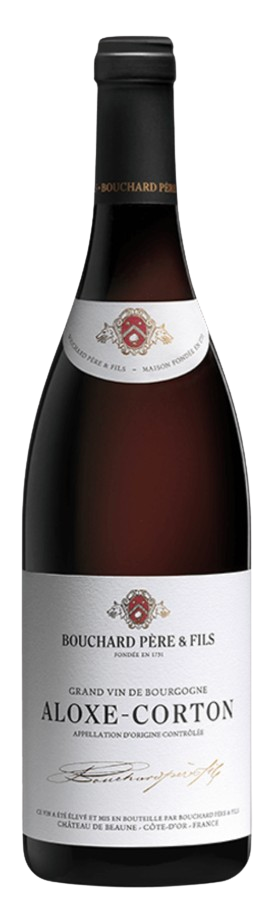
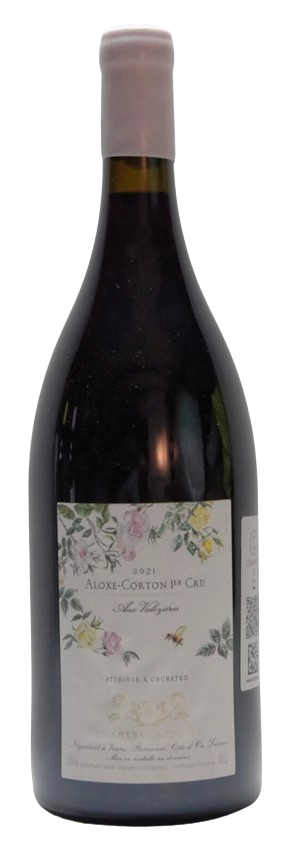
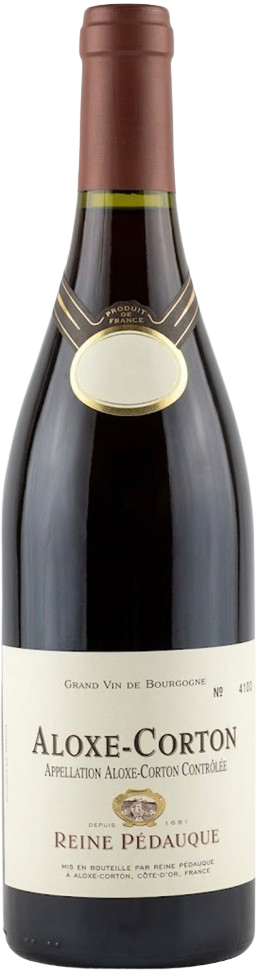
Aloxe-Corton wines on 1001caves
Detailed pages: the cuvée, the estate, the drinking window and the bottles for sale between collectors.