On the Other Side of the Route des Grands Crus
Charmes-Chambertin lies within the single commune of Gevrey-Chambertin, in the Côte-d'Or, south of Dijon. Unlike the Chambertin and the Clos de Bèze, which occupy the middle of the slope, its parcels lie at the foot of the relief, between 260 and 280 metres in altitude, on a slight shelf. The cru is the Chambertin's direct neighbour: only the route des Grands Crus separates them, a very old road that is almost certainly Gallo-Roman in origin.
At nearly thirty hectares it is by far the largest of the commune's nine grands crus — the BIVB records 27.76 hectares in production in 2022 and an average crop of about 991 hectolitres, while the appellation rules speak of around 29 hectares and 1,100 hectolitres in 2009. By way of comparison, Griotte-Chambertin does not exceed three hectares. That extent goes hand in hand with extreme fragmentation: Charmes very probably has more owners than any other grand cru of Gevrey, which explains a wider spread of styles and quality levels than elsewhere.
The Terroir: The Alluvial Fan of the Combe Grisard
The geology of the cru is more composite than that of its neighbours on the slope. The shelf on which the vines sit has two halves: the western part rests on a substrate of hard Bajocian limestone, Middle Jurassic, once quarried as dressed stone; the eastern part, by contrast, rests on a deep substrate formed by the Tertiary deposits of the plain of Bresse. The whole is covered by the clay-and-gravel calcareous material of an alluvial fan issuing from a small dry valley that cuts into the hillside, the Combe Grisard.
The soils inherit an identity of their own: little evolved, generally carbonate-rich, shallow and free-draining, with a high proportion of clay and of red silts derived from the weathering of the subsoil and of the relief above. A few decimetres of gravel give the roots good penetration and favour drainage. The appellation rules put it bluntly: Charmes differs from the Chambertin "by stonier, often deeper soils". The result is moderate fertility and a well-balanced water regime, carrying off excess water while maintaining sufficient supply through dry spells.
Climate, Exposure and Production Rules
The climate is that of the whole Côte de Nuits: cool oceanic, tempered by continental or southern influences carried up the Rhône-Saône corridor, with a moderate, regular rainfall pattern — around 750 millimetres a year — with no pronounced summer drought, and an annual mean of 10.5°C. East of the Morvan and the Burgundian plateaus, the Côte enjoys a climatic shelter that gives it a thermal advantage and a notable rainfall deficit. The position of the parcels, above the footslope, protects them from frost and morning fog while ensuring an east-facing exposure that warms the soil quickly. An internal nuance: the parcels of "Aux Charmes" turn slightly to the east-north-east, those of "Mazoyères" look a little more to the south, with gradients that are always gentle — hence differences that are sometimes perceptible in the wines.
The production rules are those of the grands crus: a minimum density of 9,000 vines per hectare, rows no more than 1.25 metres apart, a maximum of eight buds per vine, a maximum load of 8,000 kilos per hectare, no irrigation, and continuous presses and wood chips banned. The sugar content of the grapes may not be less than 198 grams per litre of must, for a minimum natural alcohol level of 11.5%. The base yield is set at 45 hl/ha and the maximum at 53 hl/ha — one notch above the Chambertin and the Clos de Bèze, limited to 42 and 49 hl/ha, a regulatory difference that reflects the traditional hierarchy between the two leading crus and the other seven. Ageing runs at least until 15 June of the year following the harvest, release to market from 30 June.
The Style of the Wines and their Ageing
The appellation rules sum the cru up in one phrase: "a dense tannic frame, accompanied by great finesse". The aromas are complex and readily blend red fruit, spice and notes of undergrowth. This is a rounder Gevrey, more charming at first than the Chambertin — the deeper, gravellier soil of the alluvial fan has much to do with it — but one that keeps the commune's backbone.
Its longevity is described as considerable, and a few years' cellaring are needed for the wine to reveal its full potential. At table it follows the customs of the Gevrey grands crus: game grilled or in a wine sauce, lamb, coq au vin, rib of beef, powerful cheeses. Given the number of owners, this is the Gevrey appellation where the choice of estate weighs most heavily — even more than the vintage.
Charmes and Mazoyères: Two Lieux-Dits, One Name on the Label
This is the peculiarity that explains everything else. The delimited area of Charmes-Chambertin covers two lieux-dits: "Aux Charmes" and "Mazoyères". Yet Mazoyères-Chambertin is also, separately, a grand cru AOC in its own right. The Charmes rules say so in black and white: "following common usage, wines from grapes harvested on the parcels of the lieu-dit 'Mazoyères', lying immediately to the south, may take the name 'Charmes-Chambertin'". The BIVB confirms that it is indeed Charmes-Chambertin that is usually claimed for both.
Hence the spectacular gap in surface area between the two appellations: the BIVB records 27.76 hectares in production for Charmes-Chambertin in 2022 against only 2.89 hectares for Mazoyères-Chambertin. That is not a difference in vineyard size but a difference in declaration: virtually all the owners of Mazoyères claim the better-known name. The mechanism is a cousin of the one that allows Chambertin-Clos de Bèze to be sold as Chambertin — and, like it, it works in one direction only: no wine from "Aux Charmes" may be labelled Mazoyères-Chambertin.
From Stubble to Grand Cru: The Story of the Name
The place names tell of poor ground. "Charmes", close to "chaumes", very likely refers to lean, stony, dry soils — exactly what the geology of the alluvial fan describes. "Mazoyères", for its part, preserves the memory of a cluster of houses that vanished long ago. The reputation of these climats, adjacent to the famous Chambertin, seems to have been established by the 18th century: the wines sold dear and were often linked to their illustrious neighbour.
By the early 20th century, the habit of selling the wines of Les Charmes under the name "Charmes-Chambertin" had become common; that is what the Dijon court ruling of 1931 confirmed, defining the appellation of origin and fixing its limits. By officially attaching the name "Chambertin" to that of the lieu-dit, the ruling endorsed the kinship with the archetype of the great red Burgundies. The AOC was recognised by decree in 1937, the parcel boundaries being approved by the INAO at its session of 17 and 18 May 1984. In 1855, Jules Lavalle had classified the wines of these climats partly as première cuvée and partly as seconde — a nuanced judgement that the cru's present-day diversity does nothing to contradict.
The grape varieties of Charmes-Chambertin
Charmes-Chambertin wines on 1001caves
Detailed pages: the cuvée, the estate, the drinking window and the bottles for sale between collectors.
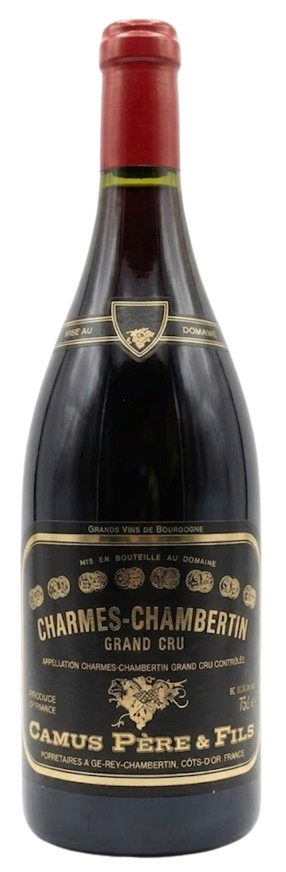 Camus Père et Fils - Charmes-Chambertin Grand Cru 2013Grand Cru · Charmes-Chambertin→
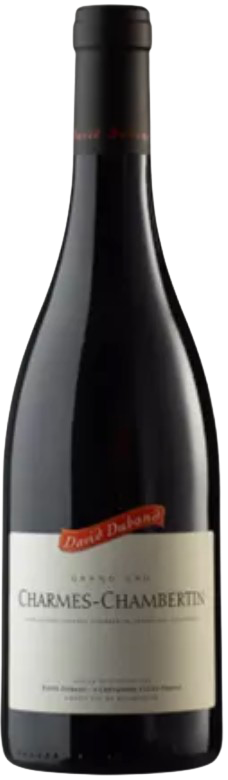 David Duband - Charmes-Chambertin Grand Cru 2020Grand Cru · Charmes-Chambertin Grand Cru→
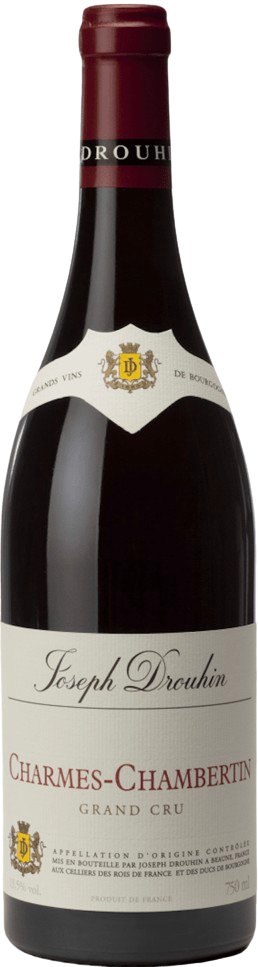 Domaine Drouhin - Charmes-Chambertin Grand Cru 2017Grand Cru · Charmes-Chambertin Grand Cru→
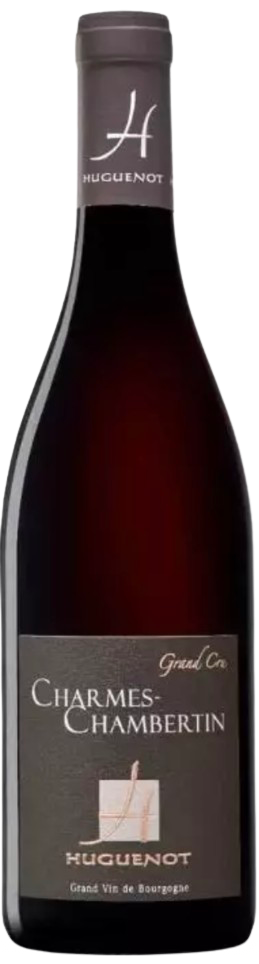 Huguenot Charmes-Chambertin Grand Cru 2023Grand Cru · Charmes-Chambertin→