An Appellation in the North of the Côte de Nuits
Fixin lies about ten kilometres south of Dijon, on the route des Grands Crus, between Marsannay and Gevrey-Chambertin. The appellation covers part of the commune of Fixin and spills over into that of Brochon, where the Clos de la Perrière climat in particular continues. It is one of the most northerly appellations of the Côte de Nuits, and one of the most confidential: about a hundred hectares in production, against more than four hundred at Gevrey just to the south.
This modest size partly explains its commercial discretion. Part of the crop may in fact be claimed as Côte de Nuits-Villages, of which Fixin is one of the five communes — even if, in practice, growers almost always prefer the village appellation, which is worth more. The vineyard obtained its AOC by the decree of 8 December 1936, one of the very first on the Côte.
The Terroir: An Uplifted Block that Brings the Lias Back Up
The front of the Côte here has about 150 metres of relief, between the Hautes Côtes plateaus to the west (400 to 500 m) and the Bresse plain to the east (about 250 m). It is made of a series of Middle Jurassic limestones and marls, of which the particularly compact Comblanchien limestone forms the framework. The premiers crus sit between 350 and 380 metres in altitude, facing east and south-east, on fairly homogeneous brown limestone soils that more marly nuances sometimes soften — at the Hervelets in particular.
Fixin's geological singularity lies elsewhere. Intense fracturing parallel to the relief has cut out, between Fixin and Brochon, a small tectonically uplifted block that exposes Lias marls at the foot of the slope, that is to say the Lower Jurassic — a stage buried beneath the Côte everywhere else. These deeper, more clayey piedmont soils give appreciably fleshier wines than the slope proper. Above them, the Bajocian limestones were once worked in quarries: it is from one of them that the climat of La Perrière takes its name.
Climate and Exposure
The climate of the Côte de Nuits is cool oceanic with a slight continental tendency: about 750 millimetres of rainfall a year, an average annual temperature of around 10.5°C. Winters are cold, springs damp and frost-prone, summers sunny. It is a climate at the northern limit for pinot noir, which reaches ripeness here only thanks to good exposure.
Hence the decisive importance of the slope. Facing east and south-east, the plots of Fixin catch the morning sun, which quickly dries the dew and limits fungal disease. The combes that cut into the relief are extremely deep and rocky here: too cold and too steep, they are excluded from the delimited area. The slope soils, weakly developed, carbonated, thin and very free-draining, impose on the vine a water constraint that concentrates the berries.
The Style of the Wines and Their Ageing
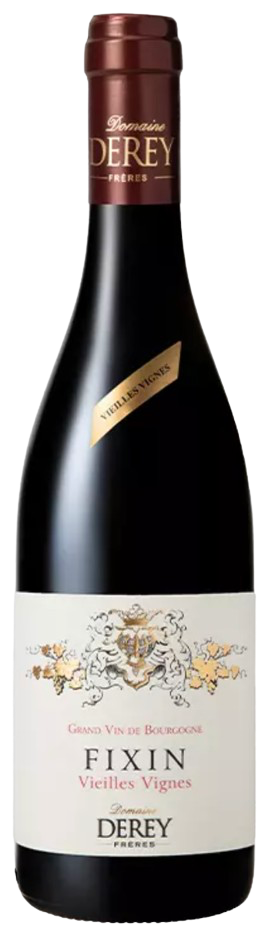
Red fixin is known for its density and its straightforwardness. Pinot noir gives deeply coloured wines here, carried by aromas of blackcurrant, blackberry and cherry, with a firmer tannic frame than the average of the Côte — a character sometimes called rustic in youth, but one that melts remarkably well. The geology can be read in the glass: more structured, mineral wines on the thin slope soils, fleshier ones on the Lias marls of the piedmont.
Ageing is most often in barrel, over twelve to twenty-four months depending on the estate. Village cuvées drink well between five and ten years; premiers crus from great vintages happily ask ten to fifteen years to open fully. The whites, confidential — fewer than six hectares in production — play on the breadth and richness of chardonnay rather than on tension.
Six Climats, as Many Historic Clos
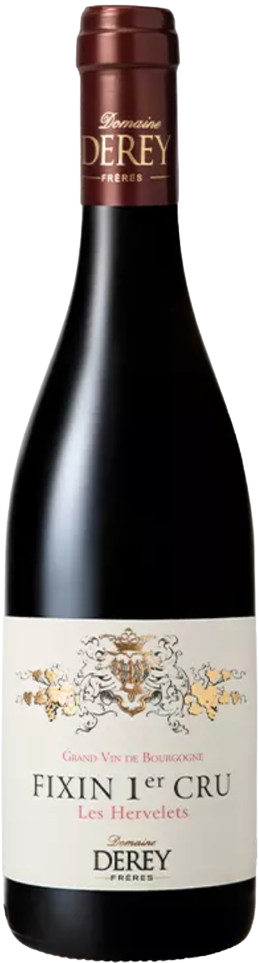
The list of Fixin's premiers crus was recognised in 1943, on the basis of the classification drawn up in 1860 by the Comité de viticulture of the arrondissement of Beaune. It counts only six climats: Clos de la Perrière, Clos Napoléon, Clos du Chapitre, Les Meix Bas, Arvelets and Hervelets. The Clos de la Perrière is a former property of the abbey of Cîteaux, attested as early as 1177 and sold in 1622 to the Dijon parliamentary family Bouhier; in 1816 Jullien placed it, in his Topographie de tous les vignobles connus, in the first class, on a par with the greatest crus of Burgundy. The Clos du Chapitre, for its part, preserves the memory of the seigneury of the Chapter of Langres.
The Clos Napoléon is a textbook case of a monopole patiently pieced back together. The climat corresponds to the cadastral lieu-dit Aux Cheusots, which in 1828 counted sixteen parcels for twelve owners. Its name was the invention of Claude Noisot, a veteran grenadier and commander under Napoleon I who settled at Fixin — he it was, too, who had François Rude's Napoléon s'éveillant à l'immortalité erected in the neighbouring park. Noisot died in 1861 without having completed the regrouping of the parcels; it took until 1955 and Pierre Gélin for the whole to come into single ownership. The Clos de la Perrière, for its part, has long been farmed by the Joliet family, who acquired it in 1853.
The grape varieties of Fixin
Fixin wines on 1001caves
Detailed pages: the cuvée, the estate, the drinking window and the bottles for sale between collectors.